
How to Read a BPC-157 Certificate of Analysis
Aug
How to Read a BPC-157 Certificate of Analysis
Published August 22, 2026 · Artemis Labs
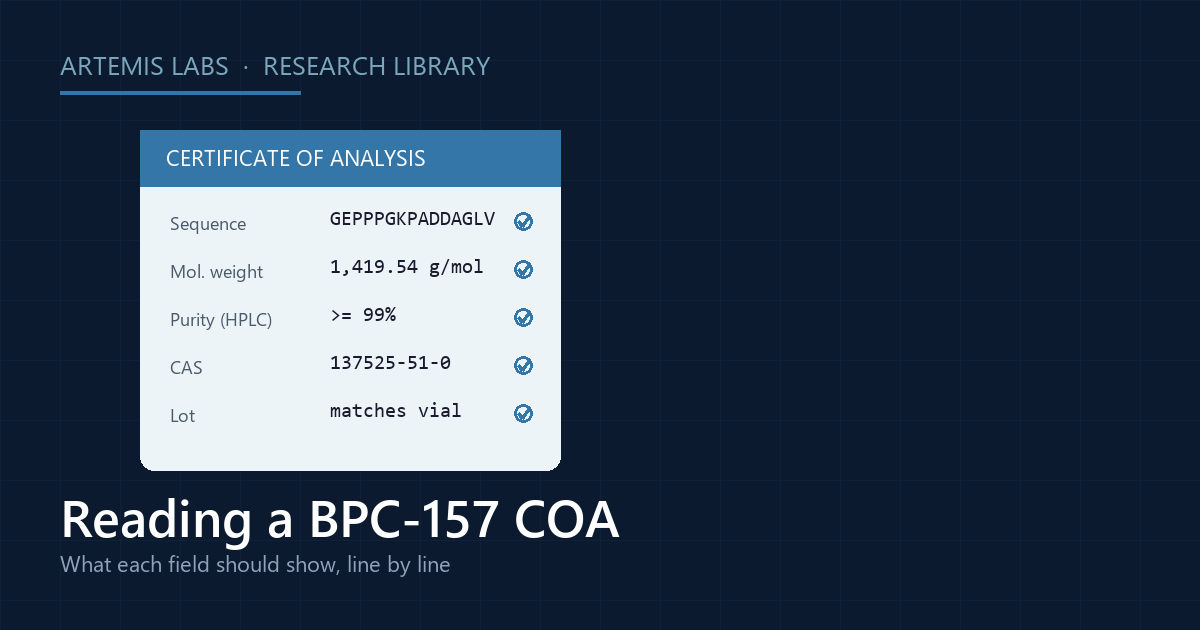
BPC-157 Certificate of Analysis — answer capsule: A Certificate of Analysis (COA) is a lab report that travels with a specific lot of a research compound. For BPC-157, a complete COA should confirm five things: the amino acid sequence GEPPPGKPADDAGLV, a molecular weight of 1,419.54 g/mol (usually checked by mass spectrometry), purity of at least 99% by reverse-phase HPLC, the compound identifiers CAS 137525-51-0 and PubChem CID 9941957, and a lot number tying the report to the exact batch in hand. Appearance should read as a white lyophilized (freeze-dried) powder. A COA describes the chemistry of one batch; it says nothing about what the compound does.
Key findings
- BPC-157 is a 15-amino-acid peptide with the sequence GEPPPGKPADDAGLV, molecular formula C₆₂H₉₈N₁₆O₂₂, and molecular weight 1,419.54 g/mol (PubChem CID 9941957).
- Research-grade BPC-157 is commonly offered against a stated purity of 99% or higher by reverse-phase HPLC, reported on a lot-specific COA.
- Two registry numbers identify the compound anywhere in the world: CAS 137525-51-0 and PubChem CID 9941957. Both should match on any BPC-157 COA.
- A COA verifies identity and purity only. No published Phase II or Phase III human efficacy trial exists for BPC-157, and no COA changes that (Mendias 2026, PMID 41966639).
What is a Certificate of Analysis, in one paragraph?
A Certificate of Analysis is a report from an analytical lab describing one batch — one “lot” — of a compound. It answers two questions. Is this the molecule the label says it is? And how much of the vial is that molecule rather than something else? Our general guide to reading a Certificate of Analysis walks through every field and how the testing works. This page does something narrower. It takes that method and applies it to a single compound, so you know the exact values a BPC-157 COA should show. Think of the general guide as the instructions and this page as the answer key for one peptide.
What should the identity fields show for BPC-157?
Identity fields prove the molecule in the vial is BPC-157 and not a different peptide. Four values matter.
Sequence. BPC-157 is a chain of 15 amino acids — the small building blocks that link together to form peptides and proteins. Written in one-letter code, the chain reads GEPPPGKPADDAGLV. Written out, that is Gly-Glu-Pro-Pro-Pro-Gly-Lys-Pro-Ala-Asp-Asp-Ala-Gly-Leu-Val. Every letter matters. A different order, or a missing link, is a different molecule. Our page on BPC-157 sequence identity covers how labs confirm the chain itself.
Molecular weight. The full chain weighs 1,419.54 g/mol, matching the molecular formula C₆₂H₉₈N₁₆O₂₂. A COA typically confirms this by mass spectrometry — a method that weighs molecules very precisely, so the measured weight can be checked against the expected one. If the measured mass sits close to 1,419.54, the molecule has the right size. A short chain, an extra amino acid, or a wrong sequence would shift the number.
CAS number. 137525-51-0. A CAS number is a registry code that identifies one specific chemical, the way a VIN identifies one specific car. Any document calling itself a BPC-157 COA should carry this number.
PubChem CID. 9941957. PubChem is a free public chemistry database run by the US National Institutes of Health, and the CID is BPC-157’s entry number there. You can look it up yourself and compare the formula and weight on the COA against the public record.
What does the purity line mean?
The purity line reports how much of the sample is BPC-157 versus everything else, such as shorter peptide fragments left over from manufacturing. The standard for research-grade material is at least 99% by reverse-phase HPLC — a lab technique that separates the parts of a mixture so each can be measured. This page will not re-teach how that separation works; our companion page on BPC-157 purity testing covers it in depth, and the COA interpretation quick reference is a printable one-page checklist of acceptable values.
What you check here is simple: the reported purity number, and that the method column says reverse-phase HPLC rather than something vaguer. A purity value with no named method is a red flag on any COA, for any compound.
What do the lot number and appearance fields tell you?
Lot number. A COA is only meaningful if it describes the exact batch you hold. The lot number on the report should match the lot number printed on the vial. A COA without a lot number, or one that does not match the vial, describes some other batch — which is the same as describing nothing.
Appearance. BPC-157 for research use is supplied as a white lyophilized powder. Lyophilized means freeze-dried: the water was removed under vacuum while the material was frozen, leaving a dry solid that stores far better than a liquid. On the COA, the appearance field should read as a white powder or cake.
How do the fields connect to each other?
The fields are not independent boxes. They cross-check one another. The sequence GEPPPGKPADDAGLV predicts the formula C₆₂H₉₈N₁₆O₂₂, which predicts the weight 1,419.54 g/mol, which the mass spectrometry result should match. The CAS number and PubChem CID both point to the same public record carrying those same values. When one field disagrees with the rest — a mass that does not fit the sequence, a CAS number for a different compound — the document has a problem, no matter how good the purity number looks. Reading a COA well mostly means checking that its parts agree.
What a COA does not show
A COA is a chemistry document. It can tell you the vial contains 15-amino-acid BPC-157 at 99% purity. It cannot tell you anything about what BPC-157 does in a living system. There is no published Phase II or Phase III human efficacy trial of BPC-157 for any use; the research record is built on animal and tissue studies, plus early human safety work referenced in recent reviews (Mendias 2026; Mayfield 2026). A perfect COA and a strong research record are different things, and a certificate is evidence for only the first.
Frequently asked questions
What molecular weight should a BPC-157 COA show?
1,419.54 g/mol, matching the formula C₆₂H₉₈N₁₆O₂₂. Mass spectrometry results should land close to this value.
What purity is standard for research-grade BPC-157?
At least 99%, measured by reverse-phase HPLC, reported per lot. The method should be named on the certificate.
Can I verify the identifiers on a COA myself?
Yes. CAS 137525-51-0 and PubChem CID 9941957 are public registry numbers. The PubChem entry lists the sequence, formula, and weight, so you can compare a COA against it line by line.
Does a good COA mean the compound works?
No. A COA confirms identity and purity of one batch. Questions about biological effects belong to the research literature, where no human efficacy trial of BPC-157 has been published.
References
- PubChem. BPC-157 (pentadecapeptide BPC 157), Compound Summary. PubChem CID 9941957. https://pubchem.ncbi.nlm.nih.gov/compound/9941957
- Mendias CL, Awan TM. Sports Med. 2026. PMID 41966639
- Mayfield CK, et al. Am J Sports Med. 2026. PMID 41476424
Methodology: Drawn from the Artemis Labs BPC-157 verified facts sheet (compiled August 22, 2026), the PubChem compound record for CID 9941957, and the cited PubMed-indexed reviews; identifiers last verified August 22, 2026.
All compounds sold by Artemis Labs are for laboratory research use only. Nothing on this page is medical advice, and no statement has been evaluated by the FDA.
