
BPC-157 Sequence and Molecular Identity Explained
Aug
What Is BPC-157, Chemically? Sequence, Formula, and Identity Checks
Published August 22, 2026 · Artemis Labs
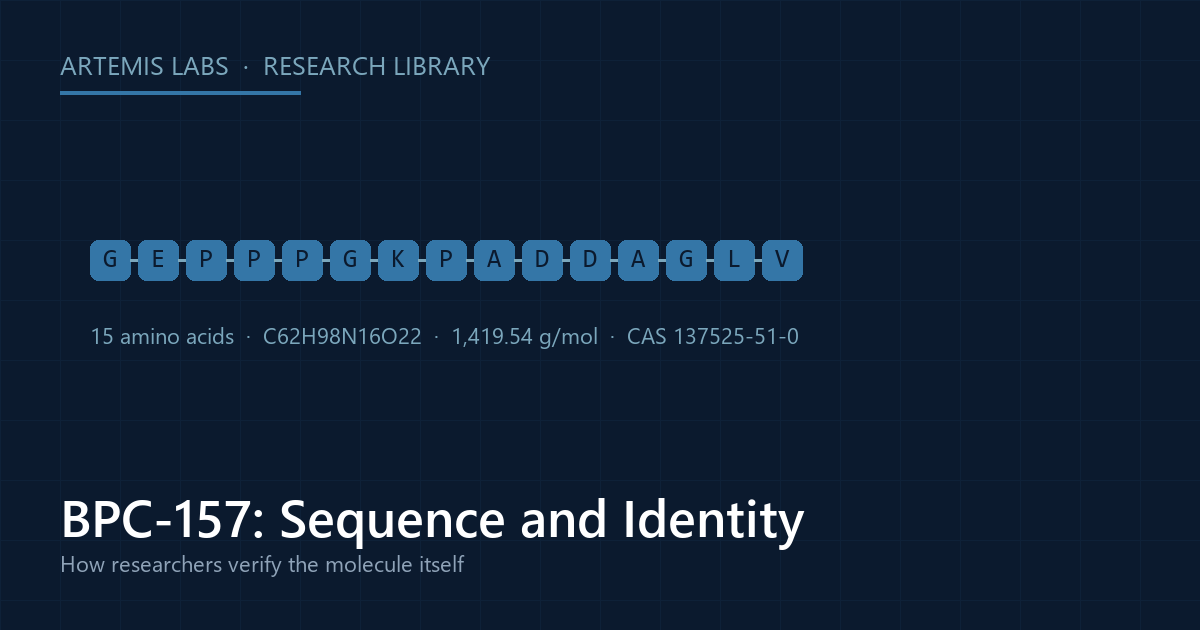
BPC-157 sequence and identity — BPC-157 is a peptide built from 15 amino acids in a fixed order: Gly-Glu-Pro-Pro-Pro-Gly-Lys-Pro-Ala-Asp-Asp-Ala-Gly-Leu-Val, written in shorthand as GEPPPGKPADDAGLV. Its molecular formula is C62H98N16O22, its molecular weight is 1,419.54 g/mol, and it is catalogued under CAS number 137525-51-0 and PubChem CID 9941957. The sequence is a partial copy of a protein found in human gastric juice, the fluid inside the stomach. Two lab tests are used to check that a vial holds the real compound: mass spectrometry, which measures whether the molecule weighs what the formula predicts, and high-performance liquid chromatography (HPLC), which measures how much of the powder is the peptide and how much is something else.
Key findings
- BPC-157 has one published, verifiable identity: 15 amino acids in the order GEPPPGKPADDAGLV, formula C62H98N16O22, weight 1,419.54 g/mol, CAS 137525-51-0, PubChem CID 9941957. A lot should match all five.
- The compound goes by several names in the literature, including PL 14736, Body Protection Compound 157, and stable gastric pentadecapeptide BPC 157. All describe the same molecule.
- Positions 3, 4, and 5 are all proline. Published work associates this triple-proline run with unusual resistance to enzyme breakdown, and reports the peptide staying intact in human gastric juice for more than 24 hours.
- Mass spectrometry and HPLC answer different questions. One checks what the molecule is; the other checks how pure the material is. Neither says anything about whether the compound does anything in a living system.
What does “amino acid sequence” actually mean?
Amino acids are small molecules that living things use as building blocks. String a few together in a chain and you have a peptide. String hundreds together and you have a protein. Each of the 20 standard amino acids has a name, a three-letter abbreviation, and a one-letter abbreviation.
The sequence is the order of those building blocks along the chain, read from one end to the other. That order is the whole identity of a peptide. Two peptides made from exactly the same amino acids in a different order behave like completely different compounds, the same way the same letters can spell two different words.
BPC-157 is 15 amino acids long. Written with three-letter abbreviations, the chain reads:
Gly-Glu-Pro-Pro-Pro-Gly-Lys-Pro-Ala-Asp-Asp-Ala-Gly-Leu-Val
Written with one-letter abbreviations, the same chain reads GEPPPGKPADDAGLV. Gly (glycine) becomes G, Pro (proline) becomes P, and so on down the line. Testing labs use both forms, so a certificate of analysis may show either. They carry identical information.
One detail in that string is the compound’s most distinctive structural feature. Positions three, four, and five are all proline, a stiff ring-shaped amino acid, and three in a row make that stretch of the chain hard for the body’s enzymes to cut. Published studies report that BPC-157 remains intact in human gastric juice for more than 24 hours, which is unusual for a small peptide that has not been chemically modified to survive.
Where does the sequence come from?
BPC-157 is not a molecule someone designed from scratch. Its sequence is a partial copy of a protein that occurs naturally in human gastric juice. Researchers took a fragment of that larger protein and studied the fragment on its own.
That origin explains one of the names it carries in older papers. “Stable gastric pentadecapeptide BPC 157” packs three facts into one label: stable (it resists breakdown), gastric (it came from stomach fluid), and pentadecapeptide (penta means five, deca means ten, so a peptide of 15 amino acids). The name is a description, not a claim.
Laboratories study the BPC-157 research peptide in several areas: how tendons, ligaments, and muscle heal in animal models, and how the lining of the digestive tract repairs itself in rodent models. Sikiric 2018 (DOI: 10.2174/1381612824666180608101119) synthesises that gastrointestinal work, and Matek 2026 (PMID 41754849) reviews the proposed mechanisms in tendon, ligament, and muscle models. All of it is preclinical, meaning animals and cells rather than people.
The full identity specification
The complete identity record, in one place. Each value is a reference figure a lot can be checked against.
| Property | Value | What it means in plain words |
|---|---|---|
| Amino acid sequence | Gly-Glu-Pro-Pro-Pro-Gly-Lys-Pro-Ala-Asp-Asp-Ala-Gly-Leu-Val (GEPPPGKPADDAGLV) | The order of the 15 building blocks in the chain. This is the compound’s identity. |
| Chain length | 15 amino acids | Why it is called a pentadecapeptide. |
| Molecular formula | C62H98N16O22 | An atom count: 62 carbon, 98 hydrogen, 16 nitrogen, 22 oxygen atoms per molecule. |
| Molecular weight | 1,419.54 g/mol | How much one mole of the molecule weighs. This is the number a mass spectrometer is checked against. |
| CAS number | 137525-51-0 | A unique registry number for the substance, like a catalogue ID for chemicals. |
| PubChem CID | 9941957 | The record number in PubChem, a public chemical database. |
| Aliases | BPC 157; PL 14736; Body Protection Compound 157; pentadecapeptide BPC 157; stable gastric pentadecapeptide BPC 157 | Different names in the literature for the same molecule. |
| Origin | Partial sequence of a protein found in human gastric juice | The sequence was taken from a naturally occurring human protein, not invented. |
| Physical form | Lyophilized powder | Freeze-dried, so the water has been removed and the solid keeps longer. |
| Purity standard | ≥99% by reverse-phase HPLC | At least 99 parts in 100 of the powder is the peptide itself. |
| Storage | −20°C, desiccated, protected from light | Freezer, kept dry, kept dark. |
How does a researcher confirm the vial holds the real compound?
Two analytical tests do most of the work, and a lot-specific certificate of analysis (COA) reports both. “Lot-specific” matters: the document should describe the exact batch in hand, not a sample from an earlier production run.
Mass spectrometry answers “is this the right molecule?” A mass spectrometer measures the mass of molecules in a sample. The formula C62H98N16O22 predicts a specific weight, 1,419.54 g/mol, because every atom in it contributes a known amount. A measured mass that matches the predicted figure is consistent with the intended peptide. A mass that comes back noticeably heavier or lighter means something in the chain is wrong: an amino acid missing, an extra one added, or a different compound entirely.
HPLC answers “how much of this powder is the peptide?” High-performance liquid chromatography pushes a dissolved sample through a packed column. Different molecules travel through at different speeds, so they come out separated in time, and a detector draws a peak for each one. The peptide’s peak is compared against the total of all peaks, and that ratio is the purity figure. The standard for research-grade material is at least 99% by reverse-phase HPLC; the remaining fraction is usually related peptide fragments and residues from manufacturing. Our explainer on HPLC testing covers how the method works.
Together the two tests cover the two ways a lot can be wrong. Mass spectrometry catches the wrong molecule. HPLC catches the right molecule diluted with other material. A lot that passes one and fails the other is not verified. For a walkthrough of reading these numbers off a real document, see our BPC-157 COA guide, and for how purity figures are produced and where they can mislead, our page on BPC-157 purity testing.
What the research does not show
There is no published Phase II or Phase III human efficacy trial for BPC-157 for any use. Pilot human safety work involving infusion is referenced in the review literature, including Mendias 2026 (PMID 41966639) and Mayfield 2026 (PMID 41476424), but that is safety work, not evidence that the compound produces an effect in people. Every efficacy statement anywhere in this literature is extrapolated from animal or tissue studies.
A second limit is specific to identity testing, and it is easy to miss. A clean mass spectrometry result and a 99% HPLC figure confirm chemistry, not biology. They say the molecule in the vial is the molecule on the label and that little else is mixed in. They say nothing about whether it does anything. That gap is wider here than for many compounds, because the published work describes several signalling pathways rather than one defined receptor. No standard binding assay exists to separate a positive response from a null one, and no single biomarker of activity has been agreed on.
Two status facts belong on any identity page. The FDA has not approved BPC-157 as a drug for any use, and its compounding status is unsettled and under advisory committee review. The World Anti-Doping Agency lists BPC-157 in Section S2 of its Prohibited List, banned at all times, in and out of competition. A tested athlete using it risks an anti-doping violation regardless of source or intent.
Frequently asked questions
Is PL 14736 the same thing as BPC-157?
Yes. PL 14736 is a development code for the same molecule. Body Protection Compound 157, pentadecapeptide BPC 157, and stable gastric pentadecapeptide BPC 157 are also the same compound under different names.
Why does the sequence appear in two different formats?
Both formats list the same 15 amino acids in the same order. Gly-Glu-Pro-Pro-Pro-Gly-Lys-Pro-Ala-Asp-Asp-Ala-Gly-Leu-Val uses three-letter abbreviations; GEPPPGKPADDAGLV uses one-letter abbreviations. Testing labs use whichever their software prints.
What should the molecular weight on a COA read?
The reference figure is 1,419.54 g/mol, which is what the formula C62H98N16O22 predicts. A clear mismatch means the material is not what the label says.
Does a high purity number mean the compound works?
No. Purity describes the material, not its effects. Whether the peptide produces any effect is a separate question, and one studied so far only in animals and tissue.
References
- PubChem Compound Summary, CID 9941957 (BPC-157). Identity record for sequence GEPPPGKPADDAGLV, molecular formula C62H98N16O22, molecular weight 1,419.54 g/mol, CAS 137525-51-0.
- Sikiric P, et al. (2018). Cytoprotection synthesis: vascular recruitment and gastrointestinal-tract healing. DOI: 10.2174/1381612824666180608101119
- Matek D, et al. (2026). Review of BPC-157 mechanisms in tendon, ligament, and muscle models. PMID 41754849
- Mendias CL, Awan TM. Sports Med. 2026. PMID 41966639
- Mayfield CK, et al. Am J Sports Med. 2026. PMID 41476424
Methodology: This page draws only on the verified BPC-157 research and analytical record compiled by Artemis Labs (identity values and citations last verified August 22, 2026); no facts beyond those sources.
All compounds sold by Artemis Labs are for laboratory research use only. Nothing on this page is medical advice, and no statement has been evaluated by the FDA.
