
BPC-157 Safety Research: What Studies Report
Aug
BPC-157 safety research: what the published record reports
Published August 22, 2026 · Artemis Labs
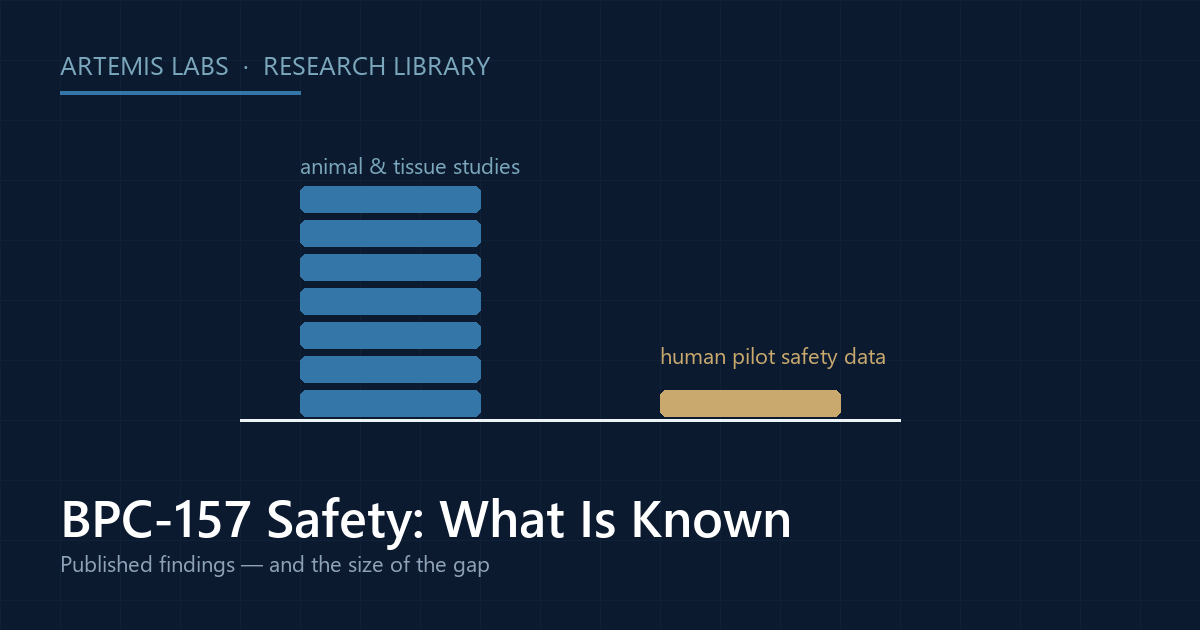
BPC-157 safety research — answer capsule: the published safety record for BPC-157 is thin. No Phase II or Phase III human efficacy trial has been published for any use. The only human safety work described in the review literature is small pilot infusion work, referenced in two 2026 reviews (Mendias, PMID 41966639; Mayfield, PMID 41476424). Everything else in the literature is animal or isolated-tissue work. An evidence base that shape cannot answer the safety question in people, and this page does not pretend otherwise.
Key findings
- There is no published Phase II or Phase III human efficacy trial for BPC-157 for any use. Every efficacy claim made about it anywhere is extrapolated from animal or tissue studies (Mendias 2026, PMID 41966639).
- The human safety work that reviewers point to is pilot infusion work — early, small studies that look for obvious problems rather than build a full safety picture (Mayfield 2026, PMID 41476424).
- Regulatory position is unsettled. BPC-157 was placed on the FDA’s interim 503A Category 2 list in September 2023, removed from it on September 27, 2024 after the nominator withdrew, and is now under Pharmacy Compounding Advisory Committee review. An advisory committee held a non-binding vote in July 2026; no final outcome should be assumed.
- The World Anti-Doping Agency lists BPC-157 in Section S2 of its Prohibited List, prohibited at all times — in and out of competition. A tested athlete who uses it risks an anti-doping violation no matter where it came from or why they used it.
What does “safety research” actually mean here?
In drug development, safety is not one study. It is a staircase. Early human trials enrol small numbers of people and watch for immediate problems. Later trials enrol hundreds or thousands, run longer, and are the stage where uncommon effects usually surface.
BPC-157 has not climbed that staircase. It is not an approved drug for any use in the United States, and no Phase II or Phase III human efficacy trial has been published — which also means none of the larger, longer, more closely monitored designs that normally generate a safety profile exist for it. What exists instead is a large preclinical corpus of animal models and laboratory tissue, plus the pilot infusion references described below.
What are the pilot human safety references, and what are they not?
Two 2026 review papers written for clinicians mention pilot human infusion safety work with BPC-157. Mendias 2026 (PMID 41966639) surveys peptide compounds in musculoskeletal medicine, approved and unapproved. Mayfield 2026 (PMID 41476424) is a peptide primer written for physicians. Both are reviews: they describe the state of the field rather than report new experiments.
A pilot safety study is the first rung. It is small and short by design. It is not evidence that the compound works, because that is not what it measures, and it is not a general safety clearance either — a study of a few people over a short window cannot detect effects that are uncommon or slow to appear. Those references are the honest floor of the human record, not a finding about the compound.
Our sibling page on BPC-157 human trials covers the trial record itself in more detail.
Where does BPC-157 stand with regulators?
The FDA has not approved BPC-157 for any use. Its compounding status has moved more than once. In September 2023 it went onto the interim 503A Category 2 list, a bucket for substances with significant safety questions. On September 27, 2024 it came off that list — not because the questions were answered, but because the party who nominated it withdrew the nomination. It now sits with the Pharmacy Compounding Advisory Committee. In July 2026 an advisory committee took a non-binding vote on a recommendation. The whole picture remains unsettled, and anyone stating a settled outcome is ahead of the record.
BPC-157 is not a federally scheduled controlled substance in the United States. Some states restrict shipping. The BPC-157 research peptide we supply is sold for laboratory research use only.
Why the anti-doping listing matters to anyone tested
WADA places BPC-157 in Section S2 of the Prohibited List, and S2 substances are prohibited at all times — not just on competition day. Athlete cases and equine-racing cases drove both its inclusion and its enforcement. For a tested athlete this is the most concrete, immediate consequence in the whole safety discussion, and it does not depend on the science being settled. Source and intent are not defences. The BPC-157 WADA status page walks through the listing.
What about the Tβ4 finding raised in blend discussions?
BPC-157 is sometimes sold combined with TB-500, a fragment related to thymosin beta-4 (Tβ4), a protein involved in tissue repair. One published finding belongs in that conversation. Sun 2025 (PMID 41278163) reported that Tβ4 released by mast cells impaired the intestinal epithelial barrier — the single-cell lining that controls what crosses the gut wall — in irritable bowel syndrome models, through the IL22RA1/JAK1/STAT3 pathway.
The bounds matter. That result is specific to Tβ4 and TB-500. It is not a finding about BPC-157, and nothing in it should be read across to BPC-157. We surface it because a combined product carries the questions attached to every component in it, and because a research supplier that only publishes flattering findings is not worth reading.
Why the animal work does not close the question
Two features of the BPC-157 literature make extrapolation harder than usual.
First, mechanism heterogeneity. BPC-157 has been linked to several signalling pathways at once rather than one defined receptor. There is no canonical binding assay — no standard laboratory test that separates a positive result from a null one — and no converged biomarker that researchers agree marks activity. A compound with no agreed activity readout is also a compound with no agreed safety readout.
Second, species and model variability. Reported effect sizes across the corpus vary substantially with the model used, the amount given, the way it was given, and the species studied. The nearest thing to human mechanism data is Yildirim 2026 (PMID 42123221), which reported nitric-oxide-mediated relaxation of human internal mammary artery tissue in a tissue bath. That is human tissue in a dish, not a clinical trial. Much of the animal literature also studies extreme induced conditions — Medvidovic Grubisic 2026 (PMID 41832718) used severe electrolyte disturbance in rats — a long way from anything resembling routine safety monitoring.
For the wider preclinical picture, see our deep dive on the BPC-157 preclinical foundation and human tissue evidence.
What the research does not show
No published Phase II or Phase III human efficacy trial exists for BPC-157 for any use. That single sentence governs everything else on this page.
Beyond it: the pilot infusion references are early and small, so they cannot describe how the compound behaves over months or in large numbers of people. There is no published long-term human follow-up, and no agreed biomarker to monitor. Regulatory review is open, not concluded. Because no defined receptor anchors the pharmacology, the usual method of predicting effects from a known mechanism is weaker here than it would be for a conventional drug.
This page reports what has been published. It does not conclude that BPC-157 is safe, and it does not conclude that it is harmful. The published record does not support either conclusion.
Frequently asked questions
Have any human safety studies of BPC-157 been published?
Pilot human infusion safety work is referenced in two 2026 clinician reviews (PMID 41966639, PMID 41476424). Pilot studies are early and small. No Phase II or Phase III human efficacy trial has been published.
Is BPC-157 approved by the FDA?
No. It is not an approved drug for any use. Its 503A compounding status changed twice between 2023 and 2024 and remains under advisory committee review, so the position is unsettled.
Can a tested athlete use BPC-157?
WADA prohibits it at all times under Section S2. A tested athlete who uses it risks an anti-doping violation regardless of the source or the reason.
Does the Sun 2025 gut-barrier finding apply to BPC-157?
No. Sun 2025 (PMID 41278163) studied Tβ4, the protein family behind TB-500. It is relevant to combined products containing TB-500 and is not a finding about BPC-157.
References
- Mendias CL, Awan TM. Sports Med. 2026. PMID 41966639
- Mayfield CK, et al. Am J Sports Med. 2026. PMID 41476424
- Yildirim A, et al. Endothelium-dependent, nitric-oxide-mediated relaxation of human internal mammary artery ex vivo. 2026. PMID 42123221
- Medvidovic Grubisic M, et al. Severe electrolyte disturbance in rats. 2026. PMID 41832718
- Sun Y, et al. Mast-cell-released Tβ4 impairs the intestinal epithelial barrier via IL22RA1/JAK1/STAT3. 2025. PMID 41278163
Methodology: this page draws on the Artemis Labs BPC-157 research record (built May 22, 2026; expanded May 23, 2026), restricted to citations carrying a verified PMID or DOI, plus the published regulatory and anti-doping status of the compound. Last verified August 22, 2026.
All compounds sold by Artemis Labs are for laboratory research use only. Nothing on this page is medical advice, and no statement has been evaluated by the FDA.
