
Is BPC-157 Banned for Athletes? WADA Status
Aug
Is BPC-157 Banned for Athletes?
Published August 22, 2026 · Artemis Labs
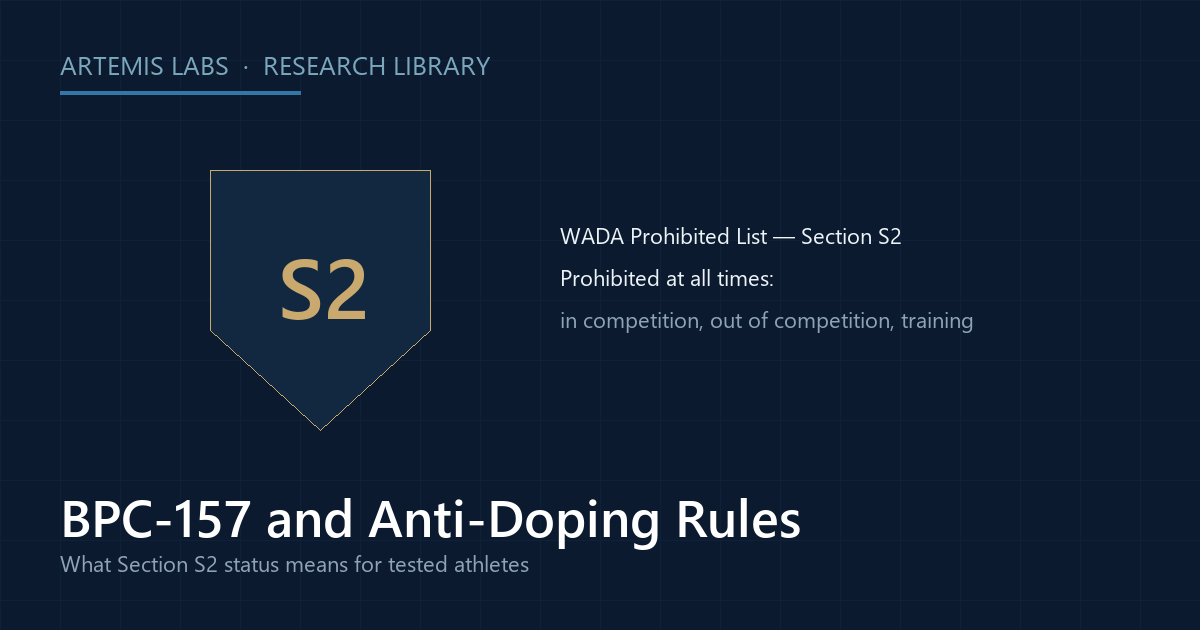
BPC-157 WADA status — answer capsule: Yes. BPC-157 appears on the World Anti-Doping Agency’s Prohibited List in Section S2, and it is prohibited at all times. “At all times” means both in competition and out of competition, including ordinary training days in the off-season. Cases involving athletes and equine racing drove BPC-157 onto the list and keep it enforced. An athlete who is subject to testing and uses BPC-157 risks an anti-doping rule violation regardless of where the compound came from or why it was taken, so a research-chemical or supplement origin is not a defense.
Key findings
- BPC-157 is listed in Section S2 of the WADA Prohibited List and carries the “prohibited at all times” designation, which covers competition days and every day between them.
- Cases in both human sport and equine racing are what pushed BPC-157 onto the list and continue to drive enforcement against it.
- Source and intent do not change the outcome for a tested athlete. A positive test is a positive test whether the compound came from a compounding pharmacy, a supplement, or a vial labeled for laboratory research.
- An anti-doping ban is a sport rule, not a criminal law. BPC-157 is not a federally scheduled controlled substance in the United States, and it is also not an FDA-approved drug. Those are three separate questions with three separate answers.
What is WADA, and what is the Prohibited List?
The World Anti-Doping Agency, usually shortened to WADA, is the international body that writes the doping rules most organized sport runs on. It is not a government and it cannot arrest anyone. What it does is set a standard that sports federations, national anti-doping organizations, and the Olympic movement adopt into their own rulebooks. When one of those bodies tests an athlete, WADA’s rules are usually the rules being applied.
Once a year WADA publishes the Prohibited List: the catalog of substances and methods an athlete under those rules may not use. The list is not a single undifferentiated pile. It is organized into sections, each covering a class of substance or method, and each section carries a status that says when the ban applies. Some sections are prohibited only in competition. Others are prohibited at all times. BPC-157 sits in Section S2, and Section S2 is one of the at-all-times sections.
What does “prohibited at all times” mean?
This is the phrase that trips people up, so it is worth spelling out. A substance banned only in competition is one an athlete must be clear of on competition day, within the testing window their sport defines around events. A substance prohibited at all times has no such window. It is banned during the season, between seasons, during rehabilitation from an injury, and on an ordinary Tuesday in training with no event on the calendar.
Athletes in testing pools can be tested out of competition, often with little or no notice, and a sample collected then is treated exactly like a competition-day sample. There is no quiet part of the year for a Section S2 substance.
Why was BPC-157 listed?
The listing did not come out of nowhere. Cases in tested sport, alongside cases in equine racing, are what drove BPC-157 onto the Prohibited List and what keep enforcement attention on it. Racing authorities run their own testing programs and laboratories, so findings there tend to surface early once a compound starts appearing in samples.
The practical result: BPC-157 is not an obscure entry a testing laboratory might overlook. It is a known target with an enforcement history behind it.
Does it matter where the compound came from?
No, and this is the single most misunderstood point on the subject. Anti-doping rules are built on strict liability, which means the athlete is responsible for what is found in their sample. The rules ask what was in the body. They do not ask how it got there, who recommended it, or what the label on the container said.
So none of the following changes the result of a positive test: that the compound was bought as a research chemical rather than a medicine, that it arrived as an ingredient in a supplement the athlete did not read closely, that a coach or clinician suggested it, or that the athlete believed it was permitted. Intent may occasionally affect the length of a sanction in a hearing, but it does not undo the violation itself. Athletes subject to testing who want a definitive answer about a specific compound should take that question to their national anti-doping organization or their sport’s compliance staff, who can check the current list against their exact situation.
We report this because researchers ordering compounds should understand the regulatory environment around what they handle. It is not guidance about using anything.
Is a WADA ban the same as being illegal?
No. These are different systems that happen to use similar-sounding words, and mixing them up leads people to badly wrong conclusions in both directions.
A WADA listing is a sport-eligibility rule. It binds athletes who have agreed to be bound, and its penalties are sport penalties: disqualified results, forfeited medals, suspensions. It has no effect on someone who is not in a testing pool.
Legal status is a separate track entirely. BPC-157 is not a federally scheduled controlled substance in the United States, though some states restrict shipping. It is also not an FDA-approved drug for any use, and its status in the FDA’s 503A compounding process remains unsettled after a non-binding advisory committee vote in July 2026. Our page on BPC-157 regulatory status covers that timeline in full, and the broader category rules are laid out in our guide to research peptides and FDA regulations. A compound can be unscheduled, unapproved, and banned in sport all at once, because each label answers a different question.
What is BPC-157 actually studied for?
Worth stating plainly, since the anti-doping listing tells you nothing about the science. BPC-157 is a 15-amino-acid peptide originally identified as a fragment of a protein found in human gastric juice. It is studied for how tendons, ligaments, and muscle heal, almost entirely in animal and cell models. Cerovecki 2010 (DOI: 10.1002/jor.21107) reported improved ligament healing in a rat knee-ligament transection model, the foundational orthopaedic study in the record. Chang 2011 (DOI: 10.1152/japplphysiol.00945.2010) reported faster outgrowth and migration of tendon cells in culture. Matek 2026 (PMID 41754849) reviews the proposed mechanisms across tendon, ligament, and muscle models.
A tissue-repair profile is the kind of thing that attracts anti-doping attention. It is not evidence that the compound does in people what the animal work observed.
What the research does not show
No published Phase II or Phase III human efficacy trial of BPC-157 exists for any use, so every claim about what it does in a person is extrapolated from animal or tissue studies. The only human work in the record is pilot infusion safety testing referenced in Mendias 2026 (PMID 41966639) and Mayfield 2026 (PMID 41476424); our page on BPC-157 human trials covers what has and has not been tested in people. On the anti-doping side, a WADA listing is a sport-governance decision, not a finding that a compound works or that it is dangerous. Being on the Prohibited List proves neither. The list also changes: it is republished annually, and the version that applies to an athlete is the one in force on the day the sample was collected, not a summary written elsewhere. The BPC-157 research peptide we supply is sold for laboratory research only, and nothing here should be read as suggesting otherwise.
Frequently asked questions
Is BPC-157 on the WADA Prohibited List?
Yes. It appears in Section S2 of the list and is prohibited at all times, meaning both in competition and out of competition.
Can an athlete use BPC-157 out of season?
No. “Prohibited at all times” has no seasonal exception. Out-of-competition testing applies to athletes in testing pools year-round, and an out-of-competition positive counts as a violation.
Does buying BPC-157 as a research compound protect an athlete from a violation?
No. Anti-doping rules work on strict liability: what matters is what is found in the sample, not how it got there or what the container was labeled. Research-chemical or supplement origin is not a defense.
Is BPC-157 illegal because WADA bans it?
No. A WADA listing is a sport rule, not a criminal statute. BPC-157 is not a federally scheduled controlled substance in the US, though it is also not an FDA-approved drug and some states restrict shipping.
References
- Cerovecki 2010. Improved ligament healing in a rat medial collateral ligament transection model. DOI: 10.1002/jor.21107
- Chang 2011. Tendon-cell outgrowth, survival, and migration via FAK–paxillin signalling. DOI: 10.1152/japplphysiol.00945.2010
- Matek 2026. Mechanism review across tendon, ligament, and muscle models. PMID 41754849
- Mendias CL, Awan TM. Sports Med. 2026. PMID 41966639
- Mayfield CK, et al. Am J Sports Med. 2026. PMID 41476424
Methodology: this page draws on the Artemis Labs BPC-157 research record (PMID- and DOI-verified citations) and the anti-doping and regulatory status facts compiled in our verified facts sheet; last verified August 22, 2026.
All compounds sold by Artemis Labs are for laboratory research use only. Nothing on this page is medical advice, and no statement has been evaluated by the FDA.
