
BPC-157 vs KPV: How the Research Differs
Aug
How do BPC-157 and KPV differ in published research?
Published August 22, 2026 · Artemis Labs
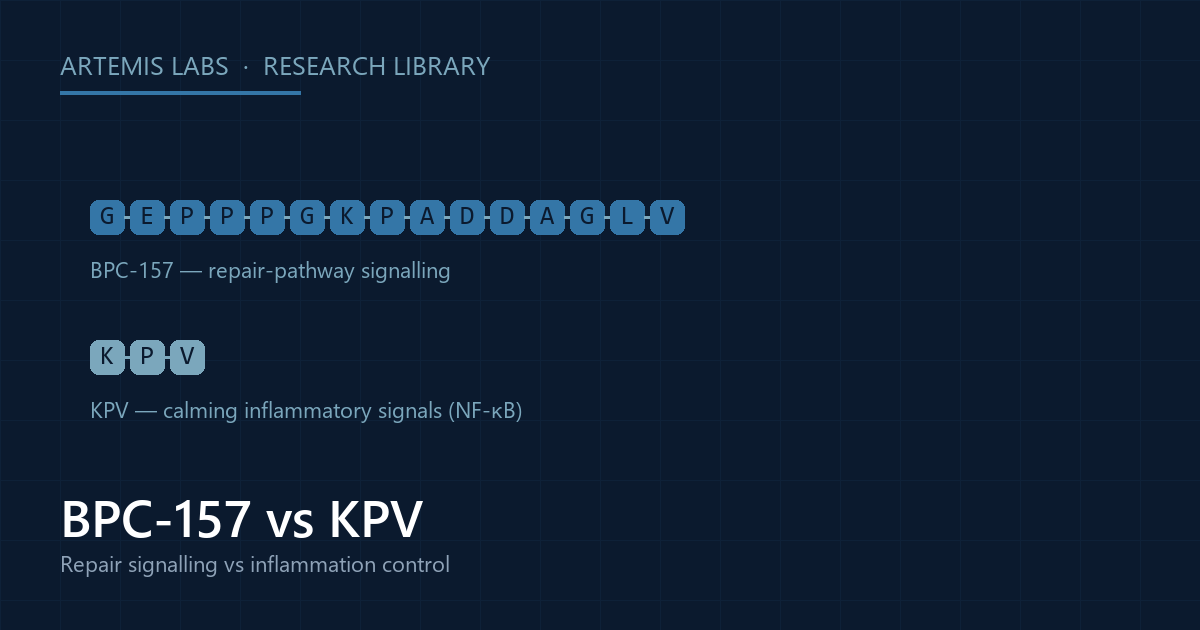
BPC-157 and KPV — answer capsule: These two compounds are studied from opposite directions. KPV is a three-amino-acid fragment taken from the tail end of α-MSH, a signalling molecule the body makes, and the research on it centres on calming inflammatory signals. BPC-157 is a 15-amino-acid peptide copied from a protein in human gastric juice, and the research on it centres on repair-pathway signalling — growth factors and new blood vessels in injured tissue. The place they meet is the intestine: KPV has been studied for suppressing NF-κB and restoring tight junctions in the gut lining, while BPC-157’s earliest animal work was on stomach and duodenal injury. Neither compound has a published human efficacy trial, so every comparison below is a comparison of research programmes, not of results in people.
Key findings
- The molecules are built differently. BPC-157 is 15 amino acids (GEPPPGKPADDAGLV, molecular weight 1,419.54 g/mol, PubChem CID 9941957). KPV is three, cut from a larger signalling molecule the body already produces.
- They belong to different research stories. KPV comes from α-MSH, but studies report it calms inflammation on its own — it enters cells and blocks NF-κB directly, and receptor-blocking experiments showed its effect does not run through the melanocortin receptors its parent uses (PMID 12750433). BPC-157 is studied through growth-factor and blood-vessel pathways, including VEGF receptor 2 with Akt and endothelial nitric oxide synthase downstream.
- Both have been studied in the intestine, which is the interesting overlap. The KPV work looks at inflammatory signalling and the seal between gut lining cells. The BPC-157 gut work is rat injury models: Amam 2018 (DOI: 10.3748/wjg.v24.i47.5366) and Kalogjera 2023 (DOI: 10.3748/wjg.v29.i27.4289).
- Neither has a published Phase II or Phase III human efficacy trial. The BPC-157 human literature is pilot safety references in reviews such as Mendias 2026 (PMID 41966639), and the KPV record states plainly that all its published efficacy data come from cell culture and rodent models.
What is KPV?
KPV is a peptide three amino acids long. Its name is the shorthand code for those three amino acids, a common way of naming very short peptides.
Where it comes from matters more than its size. KPV is a fragment cut from the end of α-MSH — alpha-melanocyte-stimulating hormone, a signalling molecule the body makes on its own. A signalling molecule is a chemical messenger: it does not do the work itself, it tells cells what to do. Researchers took the last three amino acids of that messenger and studied the fragment on its own, on the reasoning that a small piece might carry part of the parent molecule’s activity without the rest of it.
The surprise in the KPV literature is that the fragment does not work the way its parent does. α-MSH signals through a set of receptors called melanocortin receptors. KPV, tested on its own, kept an anti-inflammatory effect even when those receptors were blocked — in one experiment, a receptor-blocking compound stopped α-MSH’s effect but not KPV’s (PMID 12750433). The explanation the research settled on is that KPV is small enough to be carried into cells, where it directly blocks NF-κB from switching inflammation genes on (PMID 18061177). Inflammation is the body’s alarm response to injury or irritation, so the KPV framing points at turning the volume of the alarm down rather than at rebuilding tissue.
Two specific readouts show up in the intestinal research on KPV. The first is suppression of NF-κB, a control switch inside cells that flips on a large group of inflammation-related genes when it is activated. The second is whether tight junctions, the seals between the cells lining the intestine, come back after being loosened. Those seals decide what is allowed to cross out of the gut and what is not; when they loosen, material passes that normally would not.
What is BPC-157?
BPC-157 is a 15-amino-acid peptide. Its sequence, GEPPPGKPADDAGLV, is a partial copy of a protein found in human gastric juice — the acidic fluid the stomach makes to break food down. It carries CAS number 137525-51-0 and PubChem CID 9941957.
The research programme around it is about repair signalling rather than inflammation control. Preclinical studies report BPC-157 raising levels of VEGF receptor 2, a docking point on cells for a signal that drives the formation of new blood vessels, with Akt and endothelial nitric oxide synthase activated further down the same chain. That is the standard explanation offered for new-vessel observations at injury sites in animals. Other work reports several growth factors going up at once (VEGF, EGF, HGF) in burn, fistula, and eye models.
Cell-level work points the same way. Chang 2011 (DOI: 10.1152/japplphysiol.00945.2010) reported faster tendon-cell outgrowth and migration in culture via FAK–paxillin signalling, a pathway cells use to grip a surface and move across it. Chang 2014 (DOI: 10.3390/molecules191119066) reported more growth-hormone receptors on tendon fibroblasts, the cells that build connective tissue.
Our page on the BPC-157 gut research record covers the digestive-tract side in full.
Side by side: how does the published work compare?
| BPC-157 | KPV | |
|---|---|---|
| Size | 15 amino acids | 3 amino acids |
| Where the sequence comes from | Partial sequence of a protein found in human gastric juice | Fragment from the end of α-MSH, a signalling molecule the body makes |
| Pathway it is studied through | Growth-factor and blood-vessel pathways (VEGF receptor 2, Akt, endothelial nitric oxide synthase); FAK–paxillin; nitric oxide system | Direct NF-κB blocking inside cells — shown NOT to require the melanocortin receptors its parent α-MSH uses (PMID 12750433) |
| Research framing in one phrase | Repair-pathway signalling | Calming inflammatory signals |
| Main research areas in the literature | Tendon, ligament, muscle, gut, blood vessels, nervous system, wound healing, eye, pain, heart — all animal or tissue models | Intestinal inflammation: NF-κB suppression and tight-junction restoration |
| Human efficacy trials | None published (Phase II or Phase III); pilot safety work referenced in reviews | None published |
Where does the research on the two overlap?
The intestine is the shared ground, and the two bodies of work approach it from different angles.
The KPV research on the gut is inflammation research. NF-κB suppression and the state of the tight junctions are both measurements about signalling and barrier integrity: is the alarm running, and is the lining sealed. Nothing in that framing is about rebuilding damaged structure.
The BPC-157 gut research is injury research. Sikiric 2018 (DOI: 10.2174/1381612824666180608101119) gathers the gastrointestinal animal work under cytoprotection, the idea that a compound can help the cells lining an organ survive damage, and connects it to blood-vessel recruitment. Amam 2018 combined duodenal lesions — sores in the first section of small intestine — with a deliberately blocked major vein, in rats. Kalogjera 2023 used a rat model of a perforated stomach wall alongside obstructed circulation.
So a researcher reading both literatures is not reading two versions of the same experiment. One set asks whether inflammatory signalling in the gut lining can be quieted. The other asks whether serious structural damage in a rat digestive tract repairs differently when blood flow is compromised. Both happen to be about the gut, and that is the honest extent of the overlap.
It is also why blends pair compounds with different mechanisms, and why the framing on those has to stay careful. Complementarity is a hypothesis, not a result. No published study shows a blend outperforming its individual components.
What the research does not show
Neither compound has a published Phase II or Phase III human efficacy trial. For BPC-157 the human literature amounts to pilot safety references inside reviews such as Mendias 2026 and Mayfield 2026 (PMID 41476424), and a safety pilot does not test whether something works. Every efficacy statement about either compound is extrapolated from animal or tissue studies.
A second limit is specific to BPC-157. It has a multi-pathway profile with no single defined receptor, no canonical binding assay separating a positive result from a null one, and no agreed biomarker of activity. Effect sizes across the published corpus vary substantially with model, dose, route, and species. That makes cross-study comparison harder than it looks, and cross-compound comparison harder still.
No published head-to-head study compares BPC-157 and KPV directly. This page reads two separate research programmes on their own terms. It is not a ranking, and the absence of a comparison in the literature is itself part of the answer.
On status: BPC-157 is not an FDA-approved drug for any use. It held interim Category 2 status for 503A compounding from September 2023, was removed from that list on September 27, 2024 after the nominator withdrew, and is now under Pharmacy Compounding Advisory Committee review. A July 2026 FDA advisory committee vote was non-binding, so treat the picture as unsettled. BPC-157 is also on the WADA Prohibited List under Section S2, prohibited at all times, so a tested athlete faces an anti-doping violation regardless of where the material came from.
Frequently asked questions
Are BPC-157 and KPV studied for the same thing?
No. KPV is studied as an anti-inflammatory compound that blocks NF-κB inside cells. BPC-157 is studied through repair-pathway signalling: growth factors and blood-vessel formation in injured tissue. Their literatures touch only in the intestine, and even there they measure different things.
What is α-MSH, in plain terms?
Alpha-melanocyte-stimulating hormone is a signalling molecule the body produces — a chemical messenger that tells cells what to do rather than doing the work itself. KPV is the three-amino-acid piece from the end of it.
Has anyone tested them against each other?
Not in the published record we draw on. There is no head-to-head study, and neither compound has a human efficacy trial to compare in the first place.
Where do the other comparison compounds fit?
GHK-Cu is a copper-bound tripeptide studied mostly in skin models, covered in our BPC-157 and GHK-Cu comparison. TB-500 sits closer to BPC-157 in research area, and that comparison is set out in the BPC-157 versus TB-500 tissue repair comparison.
References
- Chang CH, et al. Tendon-cell outgrowth, survival, and migration via FAK–paxillin signalling (2011). DOI: 10.1152/japplphysiol.00945.2010
- Chang CH, et al. Growth-hormone-receptor expression in tendon fibroblasts (2014). DOI: 10.3390/molecules191119066
- Sikiric P, et al. Cytoprotection synthesis: vascular recruitment and gastrointestinal-tract healing (2018). DOI: 10.2174/1381612824666180608101119
- Amam, et al. Major venous occlusion and duodenal lesion rat model (2018). DOI: 10.3748/wjg.v24.i47.5366
- Kalogjera L, et al. Stomach-perforation and occlusion-syndrome rat model (2023). DOI: 10.3748/wjg.v29.i27.4289
- Mendias CL, Awan TM. Sports Med. 2026. PMID 41966639
- Mayfield CK, et al. Am J Sports Med. 2026. PMID 41476424
- KPV anti-inflammatory action independent of melanocortin receptors (crystal-induced peritonitis model). PMID 12750433
- KPV cellular uptake and direct NF-κB inhibition (PepT1 transporter studies). PMID 18061177
Methodology: this page draws on the Artemis Labs BPC-157 research record — peer-reviewed animal, tissue, and review literature carrying a live PMID or DOI — plus compound identity data from PubChem CID 9941957 and published FDA and WADA status. The KPV material draws on the verified Artemis Labs KPV research record; no head-to-head study of the two compounds exists. Citations last verified August 22, 2026.
All compounds sold by Artemis Labs are for laboratory research use only. Nothing on this page is medical advice, and no statement has been evaluated by the FDA.
