
BPC-157 vs GHK-Cu: How Their Research Differs
Aug
BPC-157 vs GHK-Cu: How the Two Peptides Differ in Published Research
Published August 22, 2026 · Artemis Labs
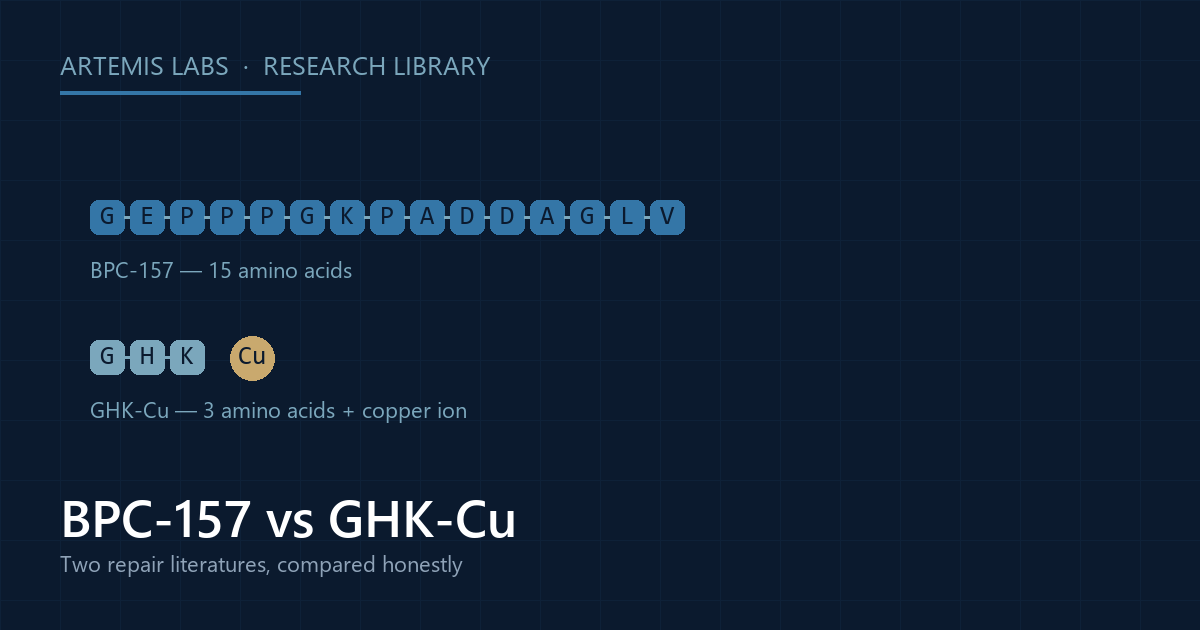
BPC-157 vs GHK-Cu — These are two different molecules studied in two different corners of the repair literature. BPC-157 is a chain of 15 amino acids, first identified as a fragment of a protein in human stomach juice, and it is studied for how tendons, ligaments, muscle, gut lining, and blood vessels repair themselves in animal models. GHK-Cu is much smaller: three amino acids bound to a copper ion, and the copper is part of what researchers study, because its proposed signalling depends on the metal it carries. GHK-Cu research is concentrated in skin and dermatology models rather than connective tissue. Neither compound has the human evidence a “which works better” question would need: BPC-157 has no published human efficacy trial at all, and GHK-Cu’s human studies are skin-surface cosmetic work that cannot isolate the peptide’s own effect. So this page compares the research programs, not the results.
Key findings
- Size and structure differ sharply: BPC-157 is 15 amino acids (sequence GEPPPGKPADDAGLV, molecular weight 1,419.54 g/mol, PubChem CID 9941957). GHK-Cu is three amino acids carrying a copper ion, making it a metal-bound peptide rather than a plain amino-acid chain.
- The proposed pathways are not the same. BPC-157 studies report growth-factor and nitric-oxide signalling, including VEGF receptor 2 with Akt and eNOS, plus FAK–paxillin cell movement (Chang 2011, DOI: 10.1152/japplphysiol.00945.2010). GHK-Cu is described as working through copper-mediated repair signalling.
- The research areas barely overlap. The BPC-157 corpus sits in tendon, ligament, muscle, gut, and blood-vessel models. GHK-Cu has been studied heavily in skin and dermatology models, and more recently in ageing models (Wen 2026, PMID 42084774).
- Human evidence differs in kind, not just amount. BPC-157 has no published Phase II or Phase III human efficacy trial — its only human work is early safety work (Mendias 2026, PMID 41966639). GHK-Cu has no controlled human trial as a standalone compound taken into the body; its human studies are skin-surface cosmetic work, largely multi-ingredient formulas that cannot isolate the peptide’s own effect.
What are BPC-157 and GHK-Cu?
Both are peptides. A peptide is a short chain of amino acids, the same building blocks that make up proteins.
The BPC-157 research peptide is 15 amino acids long. Scientists identified it as a partial sequence of a protein found in human gastric juice, the acidic fluid inside the stomach. One structural detail comes up constantly in the literature: a run of three proline amino acids in a row, associated with unusual resistance to enzyme breakdown. Published studies report the peptide stays intact in human gastric juice for more than 24 hours, rare for an unmodified peptide of this size.
The GHK-Cu research peptide is a copper-bound tripeptide. “Tripeptide” means three amino acids. The “Cu” is the chemical symbol for copper, and it signals that a copper ion is held by the peptide as part of the molecule. An ion is simply an atom carrying an electrical charge. That copper is not a packaging detail. It is central to how researchers describe the compound’s activity, which is why the literature calls it copper-mediated signalling rather than peptide signalling alone.
How do they compare side by side?
| BPC-157 | GHK-Cu | |
|---|---|---|
| Structure | Plain amino-acid chain, no metal; defining triple-proline motif | Peptide bound to a copper ion (a metal-carrying peptide) |
| Size | 15 amino acids (GEPPPGKPADDAGLV); 1,419.54 g/mol | 3 amino acids plus copper |
| Main studied pathways | VEGF receptor 2 with Akt and eNOS; nitric-oxide system; FAK–paxillin cell movement; growth-hormone-receptor expression; multi-growth-factor upregulation (VEGF, EGF, HGF) | Copper-mediated repair signalling |
| Main research areas | Tendon, ligament, muscle, gut and GI lining, blood vessels, wound repair, eye, nervous system | Skin and dermatology models |
| Human evidence | No efficacy trial published; early safety work only | No controlled trial of the compound on its own taken into the body; skin-surface cosmetic studies only, largely multi-ingredient |
Why does the structure difference matter?
A 15-amino-acid chain and a 3-amino-acid chain are not long and short versions of the same idea. Length changes what a molecule can physically do. A longer chain folds into more shapes and can touch more surfaces on a cell. A very short chain has fewer options, so when a short peptide shows activity, researchers look for something specific about it. With GHK-Cu, that something is the copper, a metal the body already uses in ordinary tissue chemistry. A peptide carrying copper can be studied as a delivery form for the metal, as a signal in its own right, or as both. That is a different research question from the one BPC-157 raises, and it produces different experiments.
BPC-157’s structural signature points the other way. The triple-proline motif is a stability feature, not a signalling one. It helps explain why the peptide survives conditions that would break down a comparable molecule.
What pathways does each one work through in published studies?
BPC-157’s proposed mechanism is spread across several pathways rather than one. Preclinical studies, meaning studies in animals and cells rather than people, report that it raised levels of VEGF receptor 2. That receptor sits on the cells lining blood vessels and responds to a signal telling the body to build new vessels. Two relay proteins further down that chain, Akt and eNOS, show activity in the same studies. Related work reports upregulation of several growth factors at once, including VEGF, EGF, and HGF, in burn, fistula, and eye models (Huang 2015, DOI: 10.2147/DDDT.S82030).
Two cell-culture findings fill in the rest. Chang 2011 reported that tendon cells grown in a dish spread outward, survived, and moved faster, through the FAK–paxillin pathway. FAK and paxillin are proteins that help a cell grip its surroundings and pull itself along. Chang 2014 (DOI: 10.3390/molecules191119066) reported that tendon fibroblasts, the cells that build connective tissue, made more receptors for growth hormone. One study reaches human tissue: Yildirim 2026 (PMID 42123221) reported nitric-oxide-mediated relaxation of human internal mammary artery tissue in a tissue bath, a sample kept alive in a lab container. It is not a clinical trial and involved no patients receiving anything.
GHK-Cu’s record describes copper-mediated repair signalling, and it carries its own recent studies. GHK is naturally present in human blood plasma — about 200 nanograms per millilitre in young adults, falling with age — and the copper-bound form is reported to change the activity of a large number of human genes involved in wound repair, collagen production, and antioxidant defence. Wen 2026 (PMID 42084774) reported that GHK-Cu extended lifespan in C. elegans, a tiny worm used as an ageing model, through effects on mitochondria — the parts of a cell that make its energy — and two stress-response pathways. Hu 2026 (PMID 41997403) reported reduced immune-cell migration and lower levels of reactive oxygen molecules in zebrafish inflammation models. Different organisms, different questions, different measurements from anything in the BPC-157 corpus — which is the point of this page.
What is each one studied for?
The two literatures point at different tissues. BPC-157 work concentrates on connective tissue and the gut. The foundational orthopaedic study is Cerovecki 2010 (DOI: 10.1002/jor.21107), which reported improved ligament healing in a rat model where the knee’s medial collateral ligament was surgically cut. Separate lines of work cover the stomach and intestinal lining (Sikiric 2018, DOI: 10.2174/1381612824666180608101119), muscle, blood-vessel formation, wounds, eyes, and nervous-system injury.
GHK-Cu’s research base is concentrated in skin and dermatology models. That is a different tissue with a different repair process and different measurements, which is the practical reason the two compounds rarely appear in the same experiment.
They do appear in the same product. GLOW combines GHK-Cu with BPC-157 and TB-500. The honest framing there is mechanism complementarity, not added benefit: no published study shows a blend outperforming its individual components. Our page on BPC-157 alone versus in blends works through that question directly.
What the research does not show
Neither compound has the human evidence that would settle anything. For BPC-157, no Phase II or Phase III human efficacy trial has been published; every efficacy statement anywhere is extrapolated from animal or tissue studies, and the human work referenced in review articles is early pilot safety work, not a test of whether it does anything (Mendias 2026, PMID 41966639). GHK-Cu’s human record is different in kind but no stronger: there is no controlled human trial of the compound on its own taken into the body. Its human studies are skin-surface cosmetic work, the most-cited of which tested a formula containing several ingredients at once, so the peptide’s own contribution cannot be separated out. A lab study on human skin samples also found that most of the copper stayed at the surface rather than passing through (PMID 20721598), so even the cosmetic evidence is tangled up in how the compound was delivered. No result on this page supports a statement about what either compound does in a person.
A direct comparison has a second problem: the two are not measured on the same scale. BPC-157 has no single defined receptor, no standard binding test separating a positive result from a null one, and no agreed biomarker of activity. Effect sizes across its corpus vary substantially with model, dose, route, and species. Set against a compound studied mainly in a different tissue with different readouts, that yields a description of two research programs, not a ranking.
One regulatory fact belongs here for BPC-157 specifically. The FDA has not approved it as a drug for any use, and its compounding status is unsettled and under advisory-committee review. It is also listed in Section S2 of the World Anti-Doping Agency Prohibited List, banned at all times, in and out of competition. A tested athlete using it risks an anti-doping violation regardless of source or intent. GHK-Cu sits differently on both counts: it was not part of the FDA’s 503A Category 2 peptide review, and it is not on the WADA Prohibited List.
Frequently asked questions
Is one of these better than the other?
The published evidence cannot answer that. They have been studied in different tissues with different measurements, and neither has a human efficacy trial. Any ranking would be an opinion dressed as a finding.
What does the “Cu” in GHK-Cu mean?
Cu is the chemical symbol for copper. It indicates that the three-amino-acid peptide carries a copper ion, and that copper is part of how the compound’s proposed repair signalling is described.
Have BPC-157 and GHK-Cu been compared head to head in a study?
Not in the record this page draws on. The comparison here is between two separate bodies of research, not between two arms of one experiment.
What about BPC-157 compared with other peptides?
We compared BPC-157 with TB-500 separately in our BPC-157 and TB-500 tissue repair comparison, and with the anti-inflammatory tripeptide KPV in BPC-157 vs KPV.
References
- Chang CH, et al. (2011). Tendon-cell outgrowth, survival, and migration via FAK–paxillin signalling. Journal of Applied Physiology. DOI: 10.1152/japplphysiol.00945.2010
- Chang CH, et al. (2014). Growth-hormone-receptor expression in tendon fibroblasts. Molecules. DOI: 10.3390/molecules191119066
- Cerovecki T, et al. (2010). Improved ligament healing in a rat MCL transection model. Journal of Orthopaedic Research. DOI: 10.1002/jor.21107
- Huang T, et al. (2015). Alkali-burn wound healing and angiogenesis readouts. Drug Design, Development and Therapy. DOI: 10.2147/DDDT.S82030
- Sikiric P, et al. (2018). Cytoprotection, vascular recruitment, and GI-tract healing. Current Pharmaceutical Design. DOI: 10.2174/1381612824666180608101119
- Yildirim S, et al. (2026). Endothelium-dependent, nitric-oxide-mediated relaxation of human internal mammary artery tissue ex vivo. PMID 42123221
- Mendias CL, Awan TM. Sports Med. 2026. PMID 41966639
- Wen et al. (2026). GHK-Cu lifespan extension in C. elegans via mitochondrial function and stress-response pathways. Biogerontology. PMID 42084774
- Hu et al. (2026). GHK-Cu in zebrafish inflammation models. Eur J Pharmacol. PMID 41997403
- In-vitro human-skin penetration study of GHK-Cu. PMID 20721598
Methodology: This page draws only on the verified Artemis Labs research records for BPC-157 and GHK-Cu (both citation sets carry live PMID or DOI links; last verified August 22, 2026); no claims beyond the cited sources.
All compounds sold by Artemis Labs are for laboratory research use only. Nothing on this page is medical advice, and no statement has been evaluated by the FDA.
