
BPC-157 Alone vs. Blends: What Actually Differs
Aug
BPC-157 Alone vs. Blends: What Is Actually Different
Published August 22, 2026 · Artemis Labs
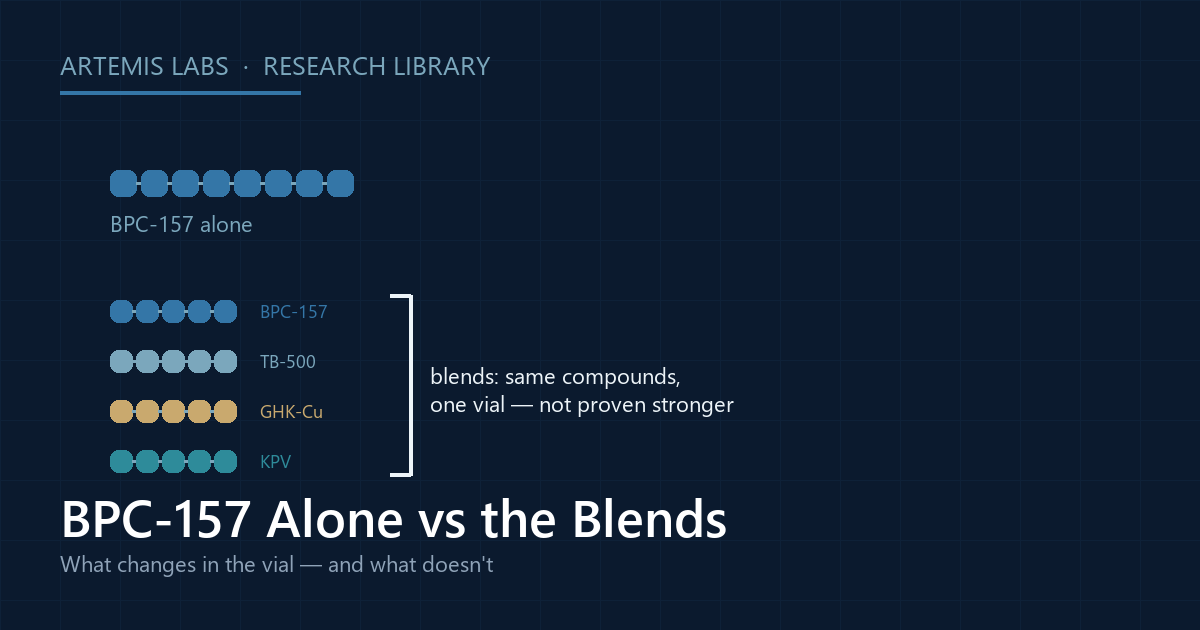
BPC-157 alone vs. blends — BPC-157 is sold two ways: on its own, and pre-mixed in a vial with other peptides. The single-compound vial contains BPC-157 and nothing else. The blends add compounds that act through different pathways: the combo vial pairs BPC-157 with TB-500, GLOW adds GHK-Cu to that pair, and KLOW adds KPV on top of GLOW. The reason researchers combine them is mechanism complementarity, meaning the compounds are believed to act on separate biological routes rather than the same one. That is a research idea about study design. No published study shows a blend performing better than its individual components, and no published human efficacy trial exists for BPC-157 in any form.
Key findings
- A standalone vial contains one compound. A blend vial contains a fixed mix that cannot be separated back out once it is made.
- The published mechanism work on BPC-157 points to growth-factor and blood-vessel pathways (Chang 2011, DOI: 10.1152/japplphysiol.00945.2010; Huang 2015, DOI: 10.2147/DDDT.S82030). GHK-Cu and KPV are studied for different routes, which is the stated rationale for pairing them.
- Mechanism complementarity is not the same as additive effect. Nothing in the published record shows the blends outperforming the compounds they are made from.
- No published Phase II or Phase III human efficacy trial exists for BPC-157, alone or blended.
What does standalone BPC-157 mean?
BPC-157 is a peptide, which is a short chain of amino acids, the same building blocks that make up proteins. This one is 15 amino acids long. Scientists first identified it as a partial sequence of a protein found in human gastric juice, the acidic fluid in the stomach. It is studied for how tendons, ligaments, muscle, gut lining, and blood vessels repair themselves in animal models.
A standalone vial of the BPC-157 research peptide holds lyophilized (freeze-dried) powder of that one compound and nothing else. Everything measured in the vial belongs to one molecule.
That matters for research design more than most people expect. When a study uses one compound and sees a result, the result can be attributed to that compound. When a vial holds four, it cannot.
What is in each blended product?
Three products in our catalog contain BPC-157 alongside other peptides. Each vial is pre-formulated, meaning the mix is fixed at manufacture. The amounts below describe what is in the vial, not any use of it.
| Product | Contents of the vial | Total peptide |
|---|---|---|
| BPC-157 (standalone) | BPC-157 only | 5 mg or 10 mg |
| BPC-157 / TB-500 combo | BPC-157 + TB-500, pre-formulated | Combined in one vial |
| GLOW | GHK-Cu 50 mg + BPC-157 10 mg + TB-500 10 mg | 70 mg |
| KLOW | GLOW plus KPV 10 mg | 80 mg |
Read down that table and the pattern is simple. The BPC-157 and TB-500 combination vial is the two-component version. GLOW is that pair with GHK-Cu added, and GHK-Cu is by far the largest share of the vial by weight. KLOW is GLOW with a fourth compound, KPV, added. Nothing is subtracted at any step.
Why are these compounds combined at all?
The stated reason is that each compound is studied for a different biological route. Put plainly, the idea is that they do not overlap.
BPC-157 is associated with growth-factor and blood-vessel signalling. Preclinical studies, meaning studies in animals and cultured cells rather than people, report that it raised levels of VEGF receptor 2, a docking point on the cells lining blood vessels that responds to a signal to build new vessels, with activity in two relay proteins named Akt and eNOS further down the chain. Chang 2011 (DOI: 10.1152/japplphysiol.00945.2010) reported faster outgrowth, survival, and movement of tendon cells in culture through the FAK–paxillin pathway, which governs how a cell grips its surroundings and pulls itself along. Huang 2015 (DOI: 10.2147/DDDT.S82030) reported raised levels of several growth factors at once in a burn-wound model in animals.
TB-500 is related to thymosin beta-4 (Tβ4), a protein involved in tissue repair. It has its own literature and its own pathway story. We already published a full side-by-side of the two compounds, so this page does not repeat it — see our BPC-157 and TB-500 tissue repair comparison.
GHK-Cu is a much smaller molecule, three amino acids bound to a copper ion, and its research record centres on copper-carried repair signalling in skin models. Our BPC-157 and GHK-Cu comparison covers that contrast in detail.
KPV is a three-amino-acid fragment taken from the tail end of a signalling molecule called α-MSH. It is studied on the melanocortin pathway for calming inflammatory signals, including work on NF-κB suppression and tight-junction restoration in the intestine. Calming a signal is a different job from building new tissue.
So the components sit on different routes. That is the entire argument for putting them in one vial, and it is worth being precise about what kind of argument it is.
Does combining them produce a bigger effect?
There is no published evidence that it does. This is the single most important sentence on this page.
Mechanism complementarity is a hypothesis about design: if two compounds act on separate pathways, a researcher may want to observe them together. It says nothing about the size of any result. Demonstrating that a blend beats its components requires a study built for exactly that question, one that compares the blend against each compound on its own, in the same model, at the same time. No such study exists in the published BPC-157 record.
Marketing language in this category often slides from the first idea to the second without naming the gap. A phrase like “synergy” implies the components multiply each other. That has not been measured here. What has been reported is that the individual compounds each have separate literatures, mostly in animals and cultured cells.
Anyone drawn to the blends for the idea of combined mechanisms will find our guide to the four-compound mix useful for the same reason: it maps what each component is studied for. See the combined BPC-157, TB-500, KPV, and GHK-Cu guide.
How does a blend change a research design?
Three practical differences follow from the mix being fixed in the vial.
Attribution. With four compounds present, an observed result cannot be traced to any one of them. A single-compound vial isolates one variable; a blend does not.
Fixed proportions. The ratio between components is set at manufacture. In GLOW, GHK-Cu is 50 mg of the 70 mg total, so the mix is weighted heavily toward one component and that weighting cannot be changed.
Inherited caveats. A blend carries every caveat attached to each of its parts. Adding compounds adds published findings to account for, including unfavourable ones.
What the research does not show
No published Phase II or Phase III human efficacy trial exists for BPC-157, in standalone or blended form. Every efficacy statement anywhere in this literature is extrapolated from animal or tissue studies. Pilot human safety work is referenced in the review literature, but safety work is not efficacy work.
The blends have no separate literature of their own. There are no published studies of GLOW or KLOW as products. What exists is the literature on each individual component, and the blends inherit it rather than adding to it.
One specific finding belongs here because it attaches to a component. Sun 2025 (PMID 41278163) reported that Tβ4 released by mast cells impaired the intestinal epithelial barrier, the single-cell lining that controls what crosses out of the gut, in irritable bowel syndrome models, through an IL22RA1/JAK1/STAT3 route. That finding is about Tβ4, the protein family behind TB-500. It is not a finding about BPC-157, and nothing in it should be read as one. It is relevant to the TB-500-containing blends specifically in intestinal-barrier research contexts, and it is the kind of inherited caveat the previous section describes.
Two status facts apply to every form. The FDA has not approved BPC-157 as a drug for any use, and its regulatory position is unsettled and under advisory committee review. The World Anti-Doping Agency lists BPC-157 in Section S2 of its Prohibited List, banned at all times, in and out of competition. A tested athlete risks an anti-doping violation regardless of source or intent, and a blend does not change that.
Frequently asked questions
What is the difference between the combo vial, GLOW, and KLOW?
They are nested. The combo vial holds BPC-157 and TB-500. GLOW is that pair plus GHK-Cu, 70 mg of peptide in total. KLOW is GLOW plus KPV, 80 mg in total.
Is a blend better than BPC-157 on its own?
No published study answers that question, in either direction. Nothing in the record shows a blend outperforming its components, and no study has compared them head to head.
Why do the blends exist if that comparison has not been done?
Because the components are studied for different pathways, and researchers working with more than one compound at a time want them in a known, fixed proportion. That is a design convenience, not a claim about results.
Does the Sun 2025 gut-barrier finding apply to standalone BPC-157?
No. Sun 2025 (PMID 41278163) studied Tβ4, the protein family behind TB-500. It is relevant to blends containing TB-500 in intestinal-barrier research contexts and is not a finding about BPC-157.
References
- Chang CH, et al. (2011). Tendon-cell outgrowth, survival, and migration via FAK–paxillin signalling. Journal of Applied Physiology. DOI: 10.1152/japplphysiol.00945.2010
- Chang CH, et al. (2014). Growth-hormone-receptor expression in tendon fibroblasts. Molecules. DOI: 10.3390/molecules191119066
- Huang T, et al. (2015). Multi-growth-factor upregulation and wound repair in an alkali-burn model. Drug Design, Development and Therapy. DOI: 10.2147/DDDT.S82030
- Seiwerth S, et al. (2018). BPC-157 compared with standard angiogenic growth factors. DOI: 10.2174/1381612824666180712110447
- Sun Y, et al. (2025). Mast-cell-released Tβ4 impairs the intestinal epithelial barrier via IL22RA1/JAK1/STAT3. PMID 41278163
Methodology: This page draws only on the verified BPC-157 research record compiled by Artemis Labs and the product records for the blends that contain it (citations last verified August 22, 2026); no claims beyond the cited sources.
All compounds sold by Artemis Labs are for laboratory research use only. Nothing on this page is medical advice, and no statement has been evaluated by the FDA.
