
BPC-157 and Tendons: What the Research Shows
Aug
BPC-157 and tendons: what does the published research actually say?
Published August 22, 2026 · Artemis Labs
BPC-157 tendon research — answer capsule: every published study on BPC-157 and tendons is preclinical, meaning it was done on cells in a dish or on animals rather than on people. The most cited paper is Chang 2011, which reported that tendon cells grew outward, survived, and moved across a culture surface faster when BPC-157 was added, and tied that to a cell-attachment signalling route called FAK–paxillin. A 2014 paper from the same group reported more growth-hormone receptor on tendon fibroblasts, the cells that build connective tissue. Two later reviews, Gwyer 2019 and Matek 2026, gathered this work alongside similar findings in other soft tissue. There is no published Phase II or Phase III human efficacy trial for tendon healing or for any other use, so none of these findings have been tested for effectiveness in people.
Key findings
- Chang 2011 reported faster tendon-cell outgrowth, survival, and migration in culture, and traced the effect to FAK–paxillin signalling, a route cells use to grip surfaces and move (DOI: 10.1152/japplphysiol.00945.2010).
- Chang 2014 reported increased growth-hormone-receptor expression in tendon fibroblasts, the connective-tissue cells that make collagen (DOI: 10.3390/molecules191119066).
- Gwyer 2019 is a review of soft-tissue-healing studies, and Matek 2026 is a review covering tendon, ligament, and muscle models. Reviews summarise other people’s experiments; they are not new experiments (DOI: 10.1007/s00441-019-03016-8; PMID 41754849).
- All of it is cell-culture or animal work. Effect sizes across the wider BPC-157 literature vary a lot depending on the model, the amount used, and the species.
What is BPC-157?
BPC-157 is a chain of 15 amino acids, the small building blocks that make up proteins. Its sequence is GEPPPGKPADDAGLV, and it is a partial copy of a protein found in human gastric juice, the fluid the stomach uses to break down food. Its molecular weight is 1,419.54 g/mol and its PubChem entry is CID 9941957.
One structural detail gets mentioned in almost every paper: three proline units sit in a row at positions three through five, a stretch associated with unusual resistance to being chopped up by enzymes. Published work reports the peptide staying intact in human gastric juice for more than 24 hours, which is odd for a small peptide that has not been chemically modified.
It is laboratory material, not a treatment.
Why did researchers look at tendons?
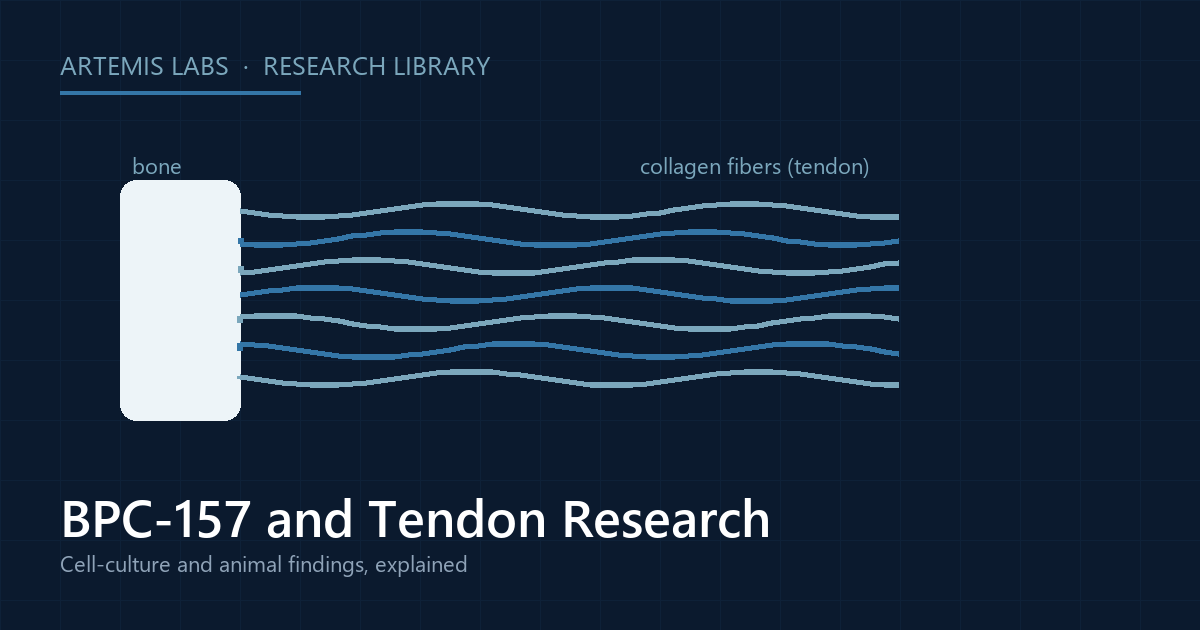
A tendon is the tough cord that ties a muscle to a bone. Tendons carry a lot of load and have a poor blood supply compared with muscle, which is one reason tendon injuries are slow and frustrating to study. Anything that appears to change how tendon cells behave gets attention from orthopaedic researchers.
BPC-157 drew that attention because early animal work in other tissues kept pointing at the same handful of repair pathways. Preclinical studies reported that BPC-157 raised levels of VEGF receptor 2, a docking point on blood-vessel cells, with downstream activation of Akt and endothelial nitric-oxide synthase. That combination is the usual signature behind new-blood-vessel formation seen at injury sites in animal models, and tendon is exactly the kind of tissue where blood supply is a bottleneck.
What did the 2011 tendon-cell study find?
Chang 2011 is the foundational tendon paper. It was done in culture, meaning tendon cells were kept alive in a dish rather than inside a living animal. With BPC-157 present, the researchers reported three things: cells grew outward from the tendon tissue more readily, more of them survived, and they migrated across the surface faster.
The paper also proposed a reason. It pointed at the FAK–paxillin pathway. FAK stands for focal adhesion kinase, and paxillin is a partner protein. Together they run the machinery a cell uses to anchor itself to the surface around it and then release and re-anchor as it moves. Cells that cannot manage that grip-and-release cycle do not migrate well, and migration is a step in how a torn tissue closes.
What the study did not do is show a healed tendon in a person. It showed cell behaviour in a dish, with a proposed signalling explanation.
What did the 2014 follow-up add?
Chang 2014 looked at tendon fibroblasts, the connective-tissue cells that produce collagen, the fibre that gives tendon its strength. The paper reported increased expression of the growth-hormone receptor on those cells. A receptor is a docking point; more receptors means a cell is set up to respond more readily to the signal that fits them.
Read together, the two Chang papers describe a proposed sequence rather than a proven one: a change in how tendon cells attach and move, plus a change in how sensitive they are to a growth signal. Both observations came from laboratory tendon-cell systems.
What do the review papers say?
Gwyer 2019 (DOI: 10.1007/s00441-019-03016-8) reviewed how soft tissue healed in animal models given BPC-157. It collects the tendon findings alongside work on other connective tissue and describes the recurring pathways. Matek 2026 is a more recent review focused on tendon, ligament, and muscle mechanisms.
Reviews are useful for seeing whether findings repeat across independent groups, and here the same pathways keep reappearing. But a review inherits the limits of what it reviews. Neither paper adds human efficacy data, because none exists to add.
How does the tendon work relate to ligament and muscle research?
Tendon, ligament, and muscle are usually studied as one cluster, and Matek 2026 covers all three for that reason. Ligaments connect bone to bone; the foundational orthopaedic study there is Cerovecki 2010, which reported improved ligament healing in a rat model with a cut medial collateral ligament. On the muscle side, Staresinic 2022 reviewed models across skeletal, smooth, and heart muscle. Our separate write-ups cover BPC-157 ligament research and BPC-157 muscle research in more detail.
For the wider picture of what is preclinical versus what has been observed in human tissue, see our overview of the BPC-157 preclinical foundation and human-tissue evidence.
What the research does not show
There is no published Phase II or Phase III human efficacy trial for BPC-157, for tendon healing or for anything else. Small pilot human safety work is referenced in the recent literature, but safety work is not efficacy work. Any claim that BPC-157 repairs a tendon in a person is extrapolated from animals and cell cultures.
Three further gaps are worth stating plainly. First, BPC-157 has no single defined receptor and no canonical binding assay, so there is no standard laboratory test that says a batch is working or not working. Second, no converged biomarker of activity has emerged, which makes results hard to compare between labs. Third, the FDA has not approved BPC-157 as a drug for any use, and its regulatory position is unsettled: it was placed on an interim compounding category in 2023, removed on September 27, 2024 after the nominator withdrew, and remains under advisory-committee review.
One more fact matters for anyone in sport. BPC-157 sits in Section S2 of the WADA Prohibited List and is banned at all times, in and out of competition. A tested athlete risks an anti-doping violation regardless of where the material came from.
Frequently asked questions
Has BPC-157 been tested on human tendons?
No. The tendon studies used cultured tendon cells and animal models. No published human efficacy trial exists for tendon repair.
What does FAK–paxillin signalling mean in plain terms?
It is the system a cell uses to grip the surface around it, let go, and grip again as it moves. Chang 2011 reported that BPC-157 acted through this route in tendon cells in culture.
Is BPC-157 approved for tendon injuries?
No. It is not an approved drug for any use in the United States, and its compounding status is still under review. Material sold by Artemis Labs is for laboratory research only.
References
- Chang 2011 — faster tendon-cell outgrowth, survival, and migration in culture via FAK–paxillin signalling. DOI: 10.1152/japplphysiol.00945.2010
- Chang 2014 — increased growth-hormone-receptor expression in tendon fibroblasts. DOI: 10.3390/molecules191119066
- Gwyer 2019 — review of BPC-157 in soft-tissue healing. DOI: 10.1007/s00441-019-03016-8
- Matek 2026 — tendon, ligament, and muscle mechanism review. PMID 41754849
- Cerovecki 2010 — rat medial collateral ligament transection model. DOI: 10.1002/jor.21107
- Staresinic 2022 — review across striated, smooth, and heart muscle models. DOI: 10.3390/biomedicines10123221
- Mendias CL, Awan TM. Sports Med. 2026. PMID 41966639
- Mayfield CK, et al. Am J Sports Med. 2026. PMID 41476424
Methodology: this page draws only on the Artemis Labs BPC-157 research record and the numbered studies above, each carrying a live PMID or DOI link; facts last verified August 22, 2026.
All compounds sold by Artemis Labs are for laboratory research use only. Nothing on this page is medical advice, and no statement has been evaluated by the FDA.
