
Why BPC-157 Is Stable: Triple-Proline and Storage
Aug
Why BPC-157 Is Unusually Stable, and How the Powder Is Stored
Published August 22, 2026 · Artemis Labs
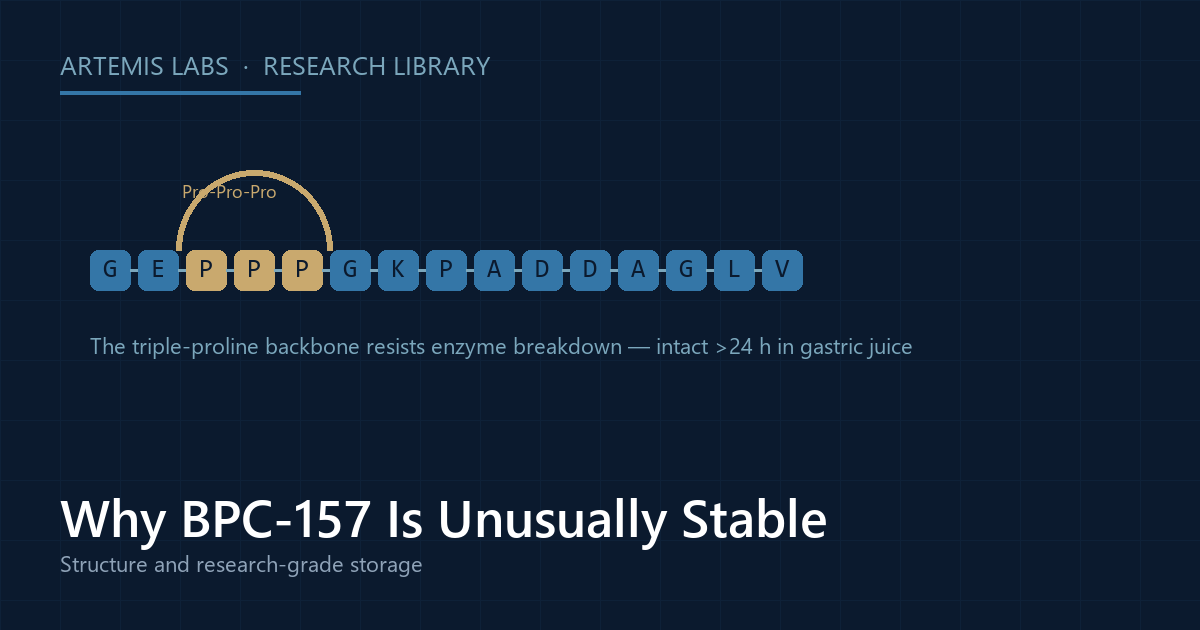
BPC-157 stability — BPC-157 is a peptide, a short chain of 15 amino acids, and it holds together far better than most peptides its size. The reason researchers point to is a structural feature called the triple-proline motif: three proline amino acids sitting side by side at positions 3, 4, and 5 of the chain. Published studies report that BPC-157 stays intact in human gastric juice, the acidic fluid inside the stomach, for more than 24 hours, which is unusual for a small peptide that has not been chemically modified. That durability is one reason the compound turns up in such a wide range of research designs. As a laboratory reagent it ships as a lyophilized powder, meaning freeze-dried, and the stated storage condition is −20°C, kept dry, and out of light.
Key findings
- BPC-157‘s sequence is GEPPPGKPADDAGLV: 15 amino acids, molecular weight 1,419.54 g/mol, CAS 137525-51-0, PubChem CID 9941957.
- Positions 3 through 5 are three prolines in a row. This triple-proline motif is the structural feature associated with the compound’s resistance to enzyme breakdown.
- Published studies report BPC-157 remaining intact in human gastric juice for over 24 hours, which is not typical for an unmodified peptide of this length.
- Storage for the freeze-dried research powder is −20°C, kept dry, and protected from light.
Why do most peptides fall apart so easily?
A peptide is a short chain of amino acids, the same building blocks proteins are made from. Amino acids link together through a connection called a peptide bond, and that bond is what a whole family of enzymes is built to cut.
Enzymes are proteins that speed up chemical reactions in the body. The ones that matter here are peptidases, enzymes whose job is to chop peptide chains into smaller pieces. They are everywhere in a living system and especially concentrated in the digestive tract, where breaking food proteins into usable parts is the entire point. A peptidase works a bit like a pair of scissors that only cuts at certain shapes. Give it a stretch of chain it recognizes, and it cuts.
This is the standard problem with small peptides in research: many survive only minutes in a biological fluid. Chemists often work around it by modifying the molecule so the scissors no longer recognize what they are holding. BPC-157 is not modified that way. Its sequence is a plain run of ordinary amino acids, which is what makes the stability reports interesting.
What is the triple-proline motif?
Proline is the odd one among the twenty standard amino acids. Where the others leave the chain relatively free to bend and rotate, proline’s side chain loops back and bonds to the backbone itself, putting a kink in the chain and locking the local shape in place.
BPC-157 has three prolines in a row at positions 3, 4, and 5, counting from the start of the sequence. Written out, the sequence is Gly-Glu-Pro-Pro-Pro-Gly-Lys-Pro-Ala-Asp-Asp-Ala-Gly-Leu-Val. Researchers describe this triple-proline run as the compound’s defining structural feature, and it is the feature associated with its unusual resistance to enzyme breakdown. A rigid, kinked stretch of chain is harder for a peptidase to grip and position for a clean cut than a loose, flexible one.
Sequence is what defines the molecule, so it is worth checking rather than assuming. Our page on the BPC-157 sequence and identity markers covers the sequence, the molecular weight, and the registry numbers a researcher can verify independently.
What does “intact for more than 24 hours in gastric juice” actually mean?
Gastric juice is the fluid in the stomach. It is strongly acidic and loaded with peptidases, which together make it one of the harshest environments a peptide can be put in. Published studies report that BPC-157 was still intact after more than 24 hours in human gastric juice.
Read that carefully, because it is a narrower statement than it first appears. It describes the molecule surviving in a fluid: a measurement of chemical durability, not a finding about whether the compound does anything useful. Those are separate questions, answered by separate studies.
The compound’s origin makes the result less surprising than it sounds. BPC-157 is a partial sequence of a protein found in human gastric juice in the first place, so it was identified in an environment that would destroy most peptides.
Why does stability matter to researchers?
A compound that survives handling is easier to study. When a molecule degrades quickly, every experiment has to be built around that fragility, and results get harder to compare between labs. Durability widens the range of study designs that are practical.
That shows up in the published record. BPC-157 is studied for how tendons, ligaments, muscles, the gut lining, blood vessels, and wounds repair themselves in animal models, along with eye, brain, heart, and pain research. Matek 2026 (PMID 41754849) reviewed the proposed mechanisms across tendon, ligament, and muscle models, and Sikiric 2018 (DOI: 10.2174/1381612824666180608101119) covered the gastrointestinal work the compound was first known for. Nearly all of it is animal or cell-culture research.
How is the research powder stored?
The BPC-157 research peptide ships as a lyophilized powder. Lyophilized means freeze-dried: the material is frozen and the water is drawn off under vacuum, leaving a dry solid. The stated storage condition for that dry powder has three parts.
−20°C. That is standard freezer temperature for laboratory reagents, and it is the temperature listed for this material.
Desiccated. Desiccated simply means kept dry. A freeze-dried powder pulls moisture out of the air if it is given the chance, so the vial is kept sealed and away from humidity.
Protected from light. The third condition is to keep the vial out of the light. Storing light-sensitive reagents in the dark is ordinary laboratory practice, and the aim is straightforward: keep the material in the same state it was in when it was tested.
It is worth being precise about what “tested” means here, because the word does a lot of work in this market. The standard purity method for a peptide is reverse-phase HPLC, a separation technique that measures how much of a sample is the intended compound. We do not currently publish batch documents. The manufacturer performs periodic quality testing on production batches. If HPLC is new to you, our HPLC testing explainer covers how the method works, and the BPC-157 certificate of analysis guide shows how to read one line by line.
What the research does not show
No published Phase II or Phase III human efficacy trial exists for BPC-157, for any use. Pilot human safety work is referenced in review articles by Mendias 2026 (PMID 41966639) and Mayfield 2026 (PMID 41476424), but every statement about what the compound does is extrapolated from animal or tissue studies.
On stability specifically, two limits are worth stating plainly. First, chemical durability says nothing about biological activity. A molecule can survive a harsh fluid and still do nothing measurable, and the two questions need different experiments. Second, we do not hold data on how long the powder holds its purity in storage, so we make no shelf-life claim. A certificate of analysis, where one exists, reports what a lot measured when it was tested; it is not a prediction about later.
BPC-157 also has no single defined receptor. It appears to act through several pathways at once, with no standard assay or biomarker to define a positive response, and effect sizes across the published corpus vary substantially with the model, dose, route, and species used.
Frequently asked questions
Is BPC-157 stable because it was chemically modified?
No. Its sequence is made of ordinary amino acids with no synthetic modifications. The resistance to enzyme breakdown is attributed to the natural triple-proline run in the chain, which is what makes it unusual among small peptides.
What is a peptidase?
A peptidase is an enzyme that cuts peptide chains into smaller pieces. They are abundant throughout the body, and they are the main reason most small peptides break down quickly.
Does surviving in gastric juice mean BPC-157 works when taken by mouth?
That is not what the finding says. The published report is that the molecule remained intact in that fluid for more than 24 hours. Whether a compound produces any effect is a separate question, and no human efficacy trial has answered it.
How long does the powder last in storage?
We do not publish a shelf-life figure because we do not hold data supporting one, and we do not currently publish batch documents either. The manufacturer performs periodic quality testing on production batches. The listed storage condition is −20°C, dry, and dark.
References
- Matek D, et al. (2026). Review of BPC-157 mechanisms in tendon, ligament, and muscle models. PMID 41754849
- Sikiric P, et al. (2018). Cytoprotection synthesis: vascular recruitment and gastrointestinal-tract healing. DOI: 10.2174/1381612824666180608101119
- Mendias CL, Awan TM. Sports Med. 2026. PMID 41966639
- Mayfield CK, et al. Am J Sports Med. 2026. PMID 41476424
Methodology: This page draws only on the verified BPC-157 research record compiled by Artemis Labs, including the PubChem CID 9941957 identity record (citations last verified August 22, 2026); no claims beyond the cited sources.
All compounds sold by Artemis Labs are for laboratory research use only. Nothing on this page is medical advice, and no statement has been evaluated by the FDA.
