
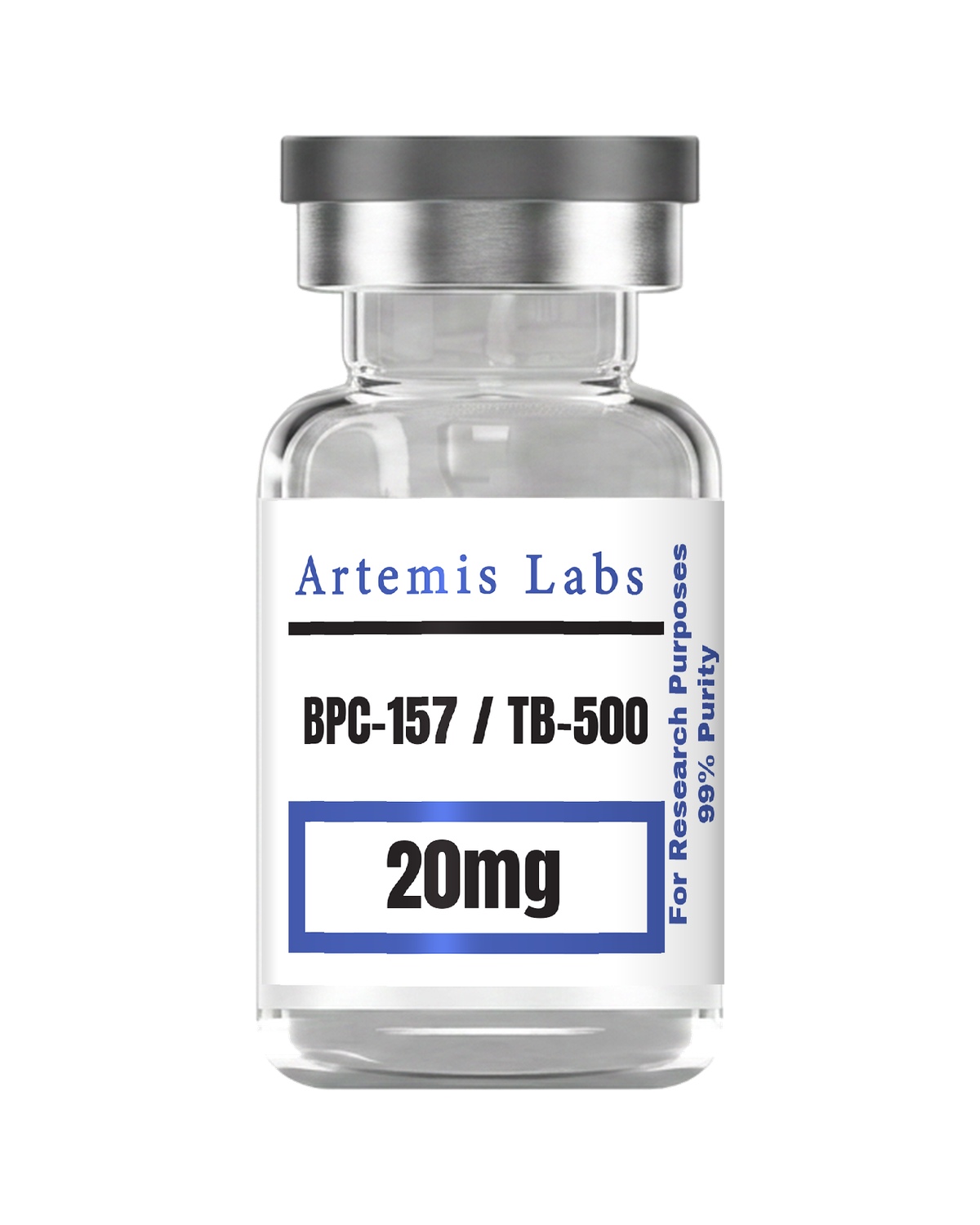
BPC-157/TB-500 Combo
$120.00
Two repair peptides that act at different points in the same process. BPC-157 works downstream — signalling that brings blood supply into damaged tissue. TB-500 works upstream, on actin, the scaffolding cells use to move and rebuild. Pairing them is an argument about non-overlapping steps, not a claim that two is better than one.
Continue readingShow less
Why the pairing is studied. The published rationale is that the two engage non-redundant pathways: BPC-157 through VEGFR2 / Akt / eNOS vascular signalling and FAK–paxillin cell migration, TB-500 through actin sequestration and cytoskeletal remodelling. No published study has tested the combination itself — the case is mechanistic, and it is stated here as such rather than dressed up as an efficacy finding.
Honest counter-evidence. Sun 2025 (PMID 41278163) reported that mast-cell-released Thymosin β4 — the parent protein TB-500 is a fragment of — impaired intestinal epithelial barrier integrity in an IBS model. That is a direct caution for gut-barrier research. Both compounds are on the WADA Prohibited List, and neither has completed human efficacy trials.
Two lyophilized peptides at ≥99% HPLC-verified purity, batch-specific Certificate of Analysis.
30 in stock
Description
The BPC-157 / TB-500 combo is a research set with two vials. BPC-157 is a small peptide copied from a stomach protein. TB-500 is a short piece of a protein called thymosin beta-4, which helps cells move. The two act on different repair paths, so labs often study them side by side. Artemis Labs sells both for lab research only.
BPC-157 has the sequence GEPPPGKPADDAGLV (CAS 137525-51-0); TB-500 is the Tβ4 17–23 fragment LKKTETQ (Tβ4 acetate CAS 77591-33-4). The 2026 human-tissue vasorelaxation data for BPC-157 is Yildirim et al. (PMID 42123221); the Tβ4 counter-evidence is Sun et al. 2025 (PMID 41278163).
Reviewed August 21, 2026 · Artemis Labs
For laboratory research use only. Not for human or veterinary consumption.
The BPC-157 / TB-500 combo supplies two of the most-studied repair-pathway peptides in preclinical literature as a single research package. Each peptide is supplied separately as a sterile lyophilised powder, analytically verified by reverse-phase HPLC to ≥99% peptide purity, and is intended for in-vitro receptor, cell-culture, tissue-bath, and pre-clinical research applications.
What is BPC-157?
A 15-residue pentadecapeptide (GEPPPGKPADDAGLV; CAS 137525-51-0; MW 1,419.54 g/mol) derived from a partial sequence of a stable human-gastric protein. Its defining structural feature is a triple-proline motif (Pro-Pro-Pro) that confers exceptional resistance to proteolytic degradation — BPC-157 remains intact in human gastric juice for >24 hours in published studies. BPC-157 is studied in preclinical literature for its multi-pathway signalling profile: VEGFR2–Akt–eNOS activation, focal adhesion kinase signalling, growth-hormone-receptor upregulation, and nitric oxide system modulation.
A 2026 ex-vivo study in human internal mammary artery tissue (Yildirim et al., J Clin Med 15(9):3488, PMID 42123221) provided the first human-tissue mechanism evidence for BPC-157’s endothelium-dependent, nitric-oxide-mediated vasorelaxation — anchoring the previously preclinical NO-pathway literature in human ex-vivo data.
What is TB-500?
A synthetic peptide modelled on residues 17–23 of Thymosin β4 (sequence LKKTETQ; Tβ4 acetate CAS 77591-33-4) — the actin-binding region of one of the most abundant intracellular regenerative peptides in mammalian tissues. The full-length parent (43 residues, ~4,963 Da) has been investigated under multiple INDs (RGN-259 / RGN-352 by RegeneRx Biopharmaceuticals) for dry-eye disease, neurotrauma, and wound healing.
TB-500 is studied via cytoskeletal protein interaction rather than classical receptor binding: G-actin sequestration modulates actin polymerisation dynamics required for cell motility, migration, and structural remodelling. Recent literature has expanded the research surface for the parent Tβ4 to candidate roles in kidney disease (Di et al. 2026, PMID 41570941), Alzheimer’s neuroinflammation (Ou et al. 2026, PMID 41443105), and brain microvascular protection (Stewart et al. 2025, PMID 41326489).
Why are BPC-157 and TB-500 studied together?
BPC-157 and TB-500 activate non-overlapping repair pathways. BPC-157 acts through downstream signalling cascades (VEGFR2-Akt-eNOS, FAK, GHR upregulation). TB-500 acts upstream through direct G-actin sequestration and stem-cell mobilisation. Their combination is mechanistically complementary — that is the published research rationale, not a claim of additive efficacy.
What are the analytical specifications?
| Component 1 | BPC-157 (Body Protection Compound 157) |
| BPC-157 sequence | GEPPPGKPADDAGLV (15 residues) |
| BPC-157 molecular weight | 1,419.54 g/mol |
| BPC-157 CAS number | 137525-51-0 |
| Component 2 | TB-500 (Thymosin β4 fragment 17–23) |
| TB-500 sequence | LKKTETQ (7 residues) |
| TB-500 CAS number | 77591-33-4 (Tβ4 acetate) |
| Parent protein | Thymosin β4, 43 residues, ~4,963 Da |
| Form | Sterile lyophilised white powder; 10 mg per vial of each peptide, vialled separately |
| Purity | ≥99% by reverse-phase HPLC |
| Identity | Confirmed by mass spectrometry |
| Endotoxin | ≤0.5 EU/mg (LAL assay, lot-specific) |
| Storage | Refer to the lot-specific Certificate of Analysis |
How does Artemis Labs verify identity and purity?
Every Artemis Labs lot ships with a third-party Certificate of Analysis confirming identity (mass spectrometry), purity (HPLC ≥99%), and endotoxin testing (≤0.5 EU/mg by LAL assay). Both peptides supplied as 10 mg lyophilised white powder per vial, packaged separately within the combo.
Methodology. Purity is measured by third-party reverse-phase HPLC and identity is confirmed by mass spectrometry; a Certificate of Analysis ships with every order.
What is the regulatory status of BPC-157 and TB-500?
Neither compound is FDA-approved for any human therapeutic indication. BPC-157 was on the FDA 503A Category 2 interim list from September 2023 to September 27 2024, then removed following nominator withdrawal; it remains under PCAC review. Both BPC-157 and TB-500 are on the WADA Prohibited List, Section S2 (Peptide Hormones, Growth Factors, Related Substances and Mimetics), prohibited at all times.
→ See the Science & Research tab below for the full reference list (16 peer-reviewed citations linked to PubMed).
References
16 linked references. Every citation opens the PubMed record.
- Yildirim AK et al. (2026) — endothelium-dependent, NO-mediated vasorelaxation of human internal mammary artery ex vivo. J Clin Med 15(9):3488. PMID 42123221
- Yuan C et al. (2026) — BPC-157 in tissue repair and pain management. Int J Mol Sci 27(6):2876. PMID 41898733
- Sikiric P (2026) — cytoprotection in hemorrhage and thrombosis. Pharmaceuticals. PMID 41901308
- Sikiric P (2026) — cytoprotective therapy in arrhythmias. Pharmaceuticals. PMID 41754776
- Smoday IM (2026) — FTIR characterisation of aortic wall remodelling in rats. Pharmaceuticals. PMID 41599787
- Matek D (2026) — tendon, ligament and muscle injury review. Pharmaceuticals. PMID 41754849
- Medvidovic Grubisic M (2026) — severe electrolyte disturbances in rats. Curr Neuropharmacol. PMID 41832718
- Di H (2026) — thymosin beta 4 as an emerging candidate for kidney diseases. Peptides. PMID 41570941
- Ou H (2026) — Tβ4-derived peptides in vitro and in 5×FAD mice. Int Immunopharmacol. PMID 41443105
- Stewart WG (2025) — Tβ4 and hypoxia-induced brain microvascular endothelial dysfunction via S1PR1. Sci Rep. PMID 41326489
- Sun YS (2025) — counter-evidence. Mast-cell-released Tβ4 impairs intestinal epithelial barrier via IL22RA1/JAK1/STAT3 in IBS. World J Gastroenterol 31(42):111706. PMID 41278163
- Simiczyjew A (2026) — comparative proteomic analysis of melanoma cell secretome. J Proteome Res. PMID 41742019
- Mavrych V et al. (2026) — therapeutic peptides in gerontology. Front Aging. PMID 42021992
- Mendias CL, Awan TM (2026) — approved and unapproved peptide therapies for musculoskeletal injuries. Sports Med. PMID 41966639
- Rahman OF et al. (2026) — therapeutic peptides in orthopaedics. JAAOS Glob Res Rev. PMID 41490200
- Mayfield CK et al. (2026) — peptide therapy primer for orthopaedic and sports medicine physicians. Am J Sports Med. PMID 41476424
For laboratory research use only. No human dosing, administration, therapeutic, diagnostic, or preventative claim is made. These statements have not been evaluated by the FDA.
Additional information
| Vial Size | 10mg/10mg combo |
|---|
Science & Research
Science & Research
Mechanism of Action — BPC-157
BPC-157 (GEPPPGKPADDAGLV) is a synthetic pentadecapeptide isolated from a stable fragment of a human gastric protein. Published research describes a multi-pathway signalling profile rather than a single defined receptor:
- VEGFR2 / Akt / eNOS axis — upregulates vascular endothelial growth factor receptor 2, driving downstream Akt phosphorylation and endothelial nitric oxide synthase activation; canonical mechanism associated with angiogenesis and vasodilation at injury sites in preclinical models.
- Focal adhesion kinase (FAK) / paxillin signalling — accelerates fibroblast and tenocyte migration into wound beds in tissue culture and rodent studies.
- Growth-hormone-receptor upregulation in tendon fibroblasts — amplifies systemic GH-mediated repair signalling.
- Nitric oxide system modulation — BPC-157 functions as a cytoprotective NO-system modulator across vascular and gastrointestinal models.
The 2026 Yildirim et al. study (PMID 42123221) demonstrated BPC-157-induced endothelium-dependent vasorelaxation in human internal mammary artery tissue ex vivo — the first human-tissue mechanistic data anchoring the previously preclinical NO-pathway literature.
Mechanism of Action — TB-500 (Thymosin β4 fragment 17–23)
TB-500 acts through cytoskeletal protein interaction rather than classical receptor binding:
- G-actin sequestration — binds monomeric G-actin and modulates actin polymerisation dynamics required for cell motility, migration, and structural remodelling.
- Stem-cell and progenitor mobilisation — full-length Tβ4 promotes recruitment and migration of stem/progenitor cells to injury sites in animal models.
- Anti-inflammatory cytokine modulation — downregulates pro-inflammatory cytokines (TNF-α, IL-1β) in models of inflammatory injury.
2024–2026 mechanism evidence — BPC-157
- First human-tissue vascular evidence (Yildirim et al. 2026, PMID 42123221) — NO-mediated vasorelaxation of human internal mammary artery ex vivo.
- Unified cytoprotection hypothesis (Sikiric 2026, PMID 41901308 + 41754776; Smoday 2026, PMID 41599787) — framed across hemorrhage, thrombosis, arrhythmia, aortic remodelling in animal models.
- Analgesic mechanism via microvascular + dopaminergic pathways (Yuan 2026, PMID 41898733).
- Tendon / ligament / muscle review (Matek 2026, PMID 41754849).
- Electrolyte homeostasis (Medvidovic Grubisic 2026, PMID 41832718).
2024–2026 mechanism evidence — TB-500 / Thymosin β4
- Renoprotective candidate (Di 2026, PMID 41570941) — Tβ4 reviewed as emerging therapeutic candidate for kidney diseases.
- Alzheimer’s neuroprotection (Ou 2026, PMID 41443105) — Tβ4-derived peptides alleviate neuroinflammation and neurite atrophy in vitro and in 5×FAD mice.
- Brain microvascular protection (Stewart 2025, PMID 41326489) — Tβ4 stabilises hypoxia-induced brain microvascular endothelial dysfunction via S1PR1 signalling.
- Counter-evidence — intestinal barrier (Sun 2025, PMID 41278163) — mast-cell-released Tβ4 impairs intestinal epithelial barrier in IBS models via IL22RA1/JAK1/STAT3. Disclosed honestly: Tβ4 is not unconditionally beneficial; tissue context matters.
Regulatory status
- BPC-157 — FDA 503A interim Category 2 (Sept 2023) → removed Sept 27 2024 following nominator withdrawal; currently under Pharmacy Compounding Advisory Committee review.
- TB-500 (Tβ4 17–23 fragment) — Not FDA-approved. Full-length Tβ4 has been investigated under multiple INDs (RGN-259 / RGN-352) for dry-eye disease, neurotrauma, and wound healing.
- WADA Prohibited List — Both compounds prohibited at all times under Section S2 (Peptide Hormones, Growth Factors, Related Substances and Mimetics).
Reference doses
Published preclinical research uses BPC-157 at 10 ng/kg to 10 μg/kg in rodent and tissue-culture models (intraperitoneal or intragastric administration). TB-500 reference doses are reported in the mg/kg range in rodent models. No human dosing guidance is provided — all reference doses are from preclinical literature.
References
All citations link directly to PubMed. Click any reference to open in a new tab.
2026 Primary Mechanism Research — BPC-157
- Yildirim AK, Dastan AO, Demeli Ertus M, Ensarioglu M, Karabacak K, Pehlivanoglu B. Endothelium-Dependent Nitric Oxide-Mediated Vasorelaxant Effects of BPC 157 in Human Internal Mammary Artery. J Clin Med. 2026;15(9):3488. PMID: 42123221.
- Yuan C, Demers A, Silva-Ortiz V, Hasoon JJ, Lee W, Dave K, Amirdelfan K, Burke HW, Christo PJ, Robinson CL. From Regeneration to Analgesia: The Role of BPC-157 in Tissue Repair and Pain Management. Int J Mol Sci. 2026;27(6):2876. PMID: 41898733.
- Sikiric P. Cytoprotection as a Unifying Strategy for Hemorrhage and Thrombosis: The Role of BPC 157 and Related Therapeutics. Pharmaceuticals (Basel). 2026. PMID: 41901308.
- Medvidovic Grubisic M. Stable Gastric Pentadecapeptide BPC 157 as a Therapy of Severe Electrolyte Disturbances in Rats. Curr Neuropharmacol. 2026. PMID: 41832718.
- Matek D. Tendon, Ligament, and Muscle Injury, Osteotendinous, Myotendinous, and Muscle-to-Bone Junction Therapy Perspectives with Growth Factors and Stable Gastric Pentadecapeptide BPC 157 — A Review. Pharmaceuticals (Basel). 2026. PMID: 41754849.
- Sikiric P. Conventional Antiarrhythmics Class I-IV, Late INa Inhibitors, IKs Enhancers, RyR2 Stabilizers, Gap Junction Modulators, Atrial-Selective Antiarrhythmics, and Stable Gastric Pentadecapeptide BPC 157 as Useful Cytoprotective Therapy in Arrhythmias. Pharmaceuticals (Basel). 2026. PMID: 41754776.
- Smoday IM. Fourier Transform Infrared Spectroscopic Characterization of Aortic Wall Remodeling by Stable Gastric Pentadecapeptide BPC 157 After Unilateral Adrenalectomy in Rats. Pharmaceuticals (Basel). 2026. PMID: 41599787.
2025–2026 Primary Mechanism Research — TB-500 / Thymosin β4
- Di H. Thymosin beta 4: An emerging therapeutic candidate for kidney diseases. Peptides. 2026. PMID: 41570941.
- Ou H. Thymosin β4-derived peptides alleviate neuroinflammation and neurite atrophy in both in vitro models and in vivo 5 × FAD mice: A potential therapy for memory improvement in Alzheimer’s disease. Int Immunopharmacol. 2026. PMID: 41443105.
- Stewart WG. Thymosin β4 stabilizes hypoxia induced brain microvascular endothelial cell dysfunction through S1PR1 dependent mechanisms. Sci Rep. 2025. PMID: 41326489.
- Sun YS. Thymosin β4 released by mast cells under stress conditions impairs intestinal epithelial barrier via IL22RA1/JAK1/STAT3 signaling in irritable bowel syndrome. World J Gastroenterol. 2025;31(42):111706. PMID: 41278163. (Counter-evidence — disclosed honestly per Artemis content policy.)
- Simiczyjew A. Comparative Proteomic Analysis of the Secretome of Control and BRAF/MEK Inhibitor-Resistant Melanoma Cells. J Proteome Res. 2026. PMID: 41742019.
Cross-Cutting Growth Hormone + Recovery Reviews
- Mavrych V, Shypilova I, Bolgova O. Therapeutic peptides in gerontology: mechanisms and applications for healthy aging. Front Aging. 2026. PMID: 42021992.
- Mendias CL, Awan TM. Safety and Efficacy of Approved and Unapproved Peptide Therapies for Musculoskeletal Injuries and Athletic Performance. Sports Med. 2026. PMID: 41966639.
- Rahman OF, Lee SJ, Seeds WA. Therapeutic Peptides in Orthopaedics: Applications, Challenges, and Future Directions. J Am Acad Orthop Surg Glob Res Rev. 2026. PMID: 41490200.
- Mayfield CK, Bolia IK, Feingold CL, Lin EH, Liu JN, Hatch GFR, Gamradt SC, Weber AE. Injectable Peptide Therapy: A Primer for Orthopaedic and Sports Medicine Physicians. Am J Sports Med. 2026. PMID: 41476424.
Reference archive: Artemis Labs maintains a 177-page reference library extracted from peer-reviewed peptide research sources (356 indexed PubMed citations + 141 DOI links). The references above are the most directly relevant to BPC-157 and TB-500 mechanism, with priority given to 2024-2026 publications. For laboratory research use only.
Related Research Compounds
Related Research Compounds
Research combination pattern note: The BPC-157 / TB-500 combination is mechanistically non-redundant — BPC-157 contributes downstream signalling (VEGFR2-Akt-eNOS, FAK, GHR) while TB-500 contributes upstream cytoskeletal remodelling (G-actin sequestration) and stem-cell mobilisation. The published research rationale is mechanistic complementarity, not additive efficacy.
For laboratory research designs that benefit from a broader repair pathway scope, three additional Artemis Labs products are mechanistically complementary:
- GHK-Cu — copper-tripeptide; complementary copper-mediated remodelling pathway. The four-peptide "Wolverine" combination pattern in research literature combines BPC-157, TB-500, KPV, and GHK-Cu.
- KPV — α-MSH C-terminal tripeptide; melanocortin-pathway anti-inflammatory adjunct, studied for intestinal NF-κB suppression and tight-junction restoration.
- MOTS-c — mitochondrial-derived peptide; downstream metabolic / bioenergetic complement to the cytoskeletal and angiogenic pathways above.
No dosing, frequency, or human-use guidance is provided. Combination commentary is restricted to in-vitro and pre-clinical research-design rationale.
FAQ
FAQ
Common questions about the BPC-157 / TB-500 research combination. All answers are for laboratory research context only — no human-use guidance is provided.
- Why are BPC-157 and TB-500 studied together?
- They activate non-overlapping repair pathways. BPC-157 acts through downstream signalling cascades (VEGFR2-Akt-eNOS, FAK, GHR upregulation). TB-500 acts upstream through direct G-actin sequestration and stem-cell mobilisation. Their combination is mechanistically complementary, which is the published rationale — not a claim of additive efficacy.
- What new 2026 human-tissue evidence exists for BPC-157?
- Yildirim et al. 2026 (Journal of Clinical Medicine 15(9):3488, PMID 42123221) demonstrated concentration-dependent, endothelium-dependent, nitric-oxide-mediated vasorelaxation of human internal mammary artery tissue ex vivo — the first human-tissue mechanism evidence for BPC-157.
- Is BPC-157 or TB-500 FDA-approved?
- No. Neither compound is FDA-approved for any human therapeutic indication. The full-length Tβ4 parent peptide has been investigated under multiple INDs (RGN-259, RGN-352) but those agents are not currently approved. BPC-157 was on the FDA 503A Category 2 interim list from September 2023 to September 27 2024, then removed following nominator withdrawal; it remains under PCAC review.
- Are these compounds prohibited in sport?
- Yes. Both BPC-157 and TB-500 are on the WADA Prohibited List, Section S2 (Peptide Hormones, Growth Factors, Related Substances and Mimetics), prohibited at all times.
- Is TB-500 the same as Thymosin β4?
- TB-500 is a synthetic peptide modelled on the active 17–23 fragment of Thymosin β4. The full-length Thymosin β4 protein is 43 residues. The marketed “TB-500” is the shorter synthetic fragment containing the key actin-binding region. They are related but not identical.
- What is BPC-157’s molecular basis for unusual stability?
- The pentadecapeptide contains a triple-proline (Pro-Pro-Pro) motif that creates a rigid backbone conformation resistant to peptidase cleavage. Published studies report BPC-157 remains intact in human gastric juice for >24 hours, which is highly unusual for an unmodified small peptide.
- Does TB-500 have any negative findings in 2024–2026 literature?
- Yes — and Artemis discloses this honestly. Sun et al. 2025 (PMID 41278163) reported that mast-cell-released Thymosin β4 impairs intestinal epithelial barrier function in IBS models via IL22RA1/JAK1/STAT3 signalling. Tβ4 is not unconditionally beneficial; tissue context matters.
- Are these compounds controlled substances?
- Neither BPC-157 nor TB-500 is currently a federally scheduled controlled substance in the United States, but state-level shipping restrictions apply. Review state shipping restrictions before ordering.
For laboratory research use only. No human dosing, administration, therapeutic, diagnostic, or preventative claim is made. These statements have not been evaluated by the FDA.
Reviews (0)
Be the first to review “BPC-157/TB-500 Combo”
Related products
weight-management
Reviews
There are no reviews yet.