
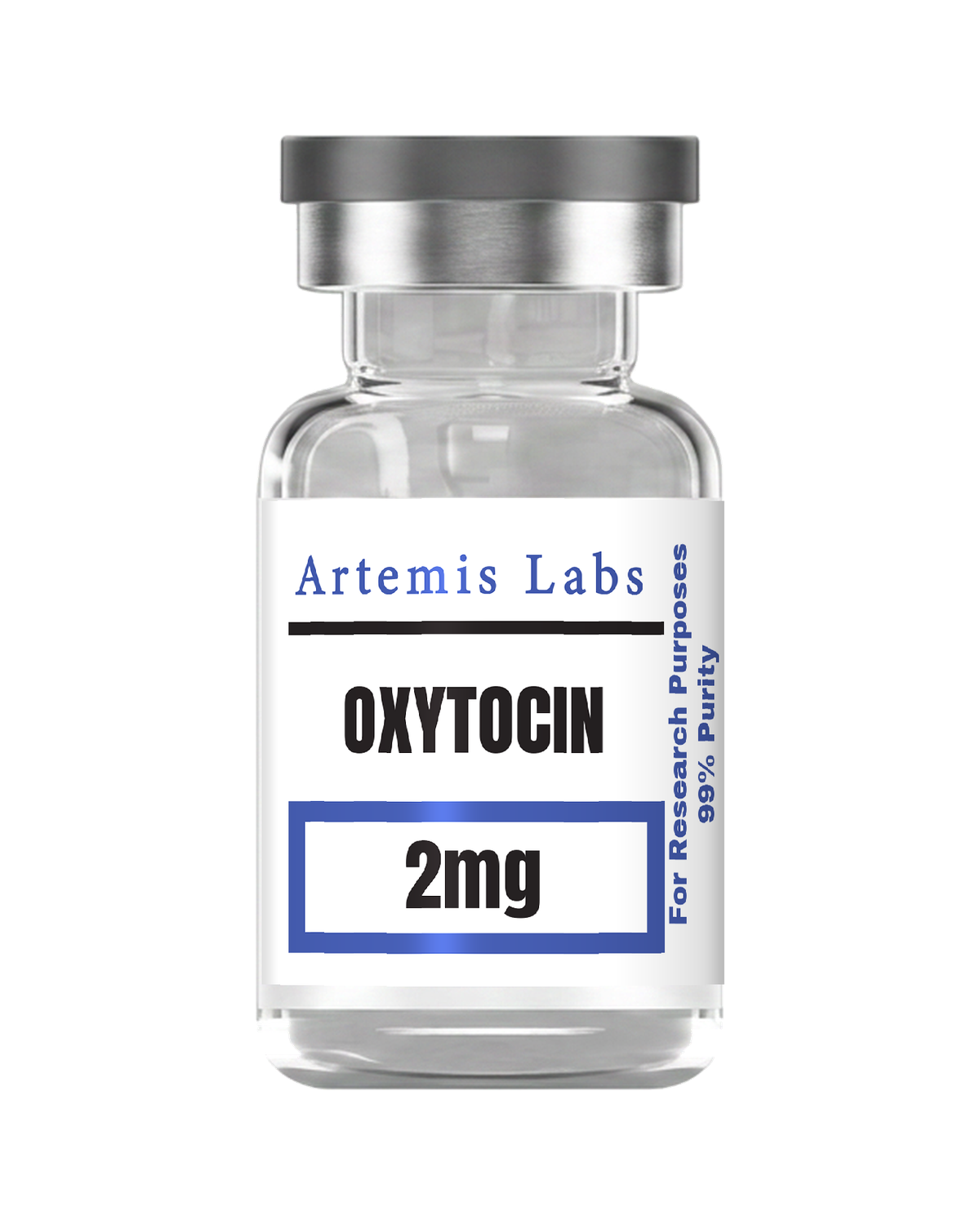
Oxytocin
$40.00
Oxytocin has a reputation as the "bonding hormone," and that framing is now looking too narrow. Work published in 2026 recasts it as a neuroimmune signal — a molecule sitting between the nervous and immune systems — which is a much more interesting research target than the social-behaviour story it is known for.
Continue readingShow less
What the newer work describes. A 2026 review reframes oxytocin as a neuroimmune-modulating neuropeptide rather than solely a social one (Sedoff 2026, PMID 42156189). A LAT1-targeted polyelectrolyte nanocomplex substantially improved intranasal-to-brain accumulation (Hu 2026, PMID 41921838), and a 4-week intranasal study in autistic children reported gut-microbiome modulation (Evenepoel 2026, PMID 41941984).
Useful safety context. The first prolonged-use endocrine-safety dataset — 8 weeks of intranasal exposure in obesity — reported no shift in reproductive hormones (Galbiati 2026, PMID 41951782). Note also that Artemis Labs oxytocin is not Pitocin®, the approved injectable form used in obstetrics.
Lyophilized 9-amino-acid cyclic neuropeptide at ≥99% HPLC-verified purity, batch-specific Certificate of Analysis.
Description
Oxytocin is a natural hormone. It is made of nine amino acids joined in a small ring. The body makes it deep in the brain, in a part called the hypothalamus. Scientists study oxytocin in social bonding and reproductive research. Artemis Labs sells a lab-grade powder. It is not Pitocin.
Reviewed August 22, 2026 · Artemis Labs
What is oxytocin?
Oxytocin is a 9-residue cyclic nonapeptide (Cys-Tyr-Ile-Gln-Asn-Cys-Pro-Leu-Gly-NH₂, intramolecular Cys¹-Cys⁶ disulfide bridge; molecular formula C₄₃H₆₆N₁₂O₁₂S₂; MW 1007.19 Da; CAS 50-56-6; DrugBank DB00107; PubChem CID 439302; ChEMBL CHEMBL395429). It is synthesised endogenously in the magnocellular neurons of the hypothalamic supraoptic and paraventricular nuclei and acts on the OXTR G-protein-coupled receptor across CNS and peripheral tissues.
Is Artemis Labs oxytocin the same as Pitocin®?
Artemis Labs oxytocin is NOT Pitocin®. Pitocin® (injectable oxytocin, Theratechnologies / Pfizer / others) is FDA-approved for labor induction and postpartum hemorrhage. Syntocinon (intranasal oxytocin) was previously available in the US for a breastfeeding indication and was discontinued in 1997. No FDA approval exists for intranasal oxytocin in any psychiatric indication. Artemis Labs does not offer or substitute for any FDA-approved oxytocin product — we supply oxytocin strictly as a research-grade reference compound for laboratory use.
What did the 2026 oxytocin research report?
The 2026 literature has materially reframed the oxytocin research narrative — specifically walking back broad ‘trust / love / autism treatment’ claims that were prominent in 2010s-era research:
- Meta-analytic walkback — Bonnieux et al. 2026 (PMID 42134427): synthesis of 42 RCTs in 1,922 participants reports a small, non-significant overall effect of intranasal oxytocin on mental-disorder symptoms. A significant effect was found in schizophrenia-spectrum disorders, with potential sex-of-participant moderator. Broad social-cognition / autism claims are NOT consistently supported.
- Autism precision-medicine framework — Boulton & Guastella 2026 (PMID 42144048): concedes that intranasal oxytocin has NOT shown consistent clinical benefit in autism, calls for precision-medicine subgrouping research approaches.
- LAT1-targeted nose-to-brain delivery — Hu et al. 2026 (PMID 41921838): an L-type amino acid transporter-targeted polyelectrolyte nanocomplex substantially improves intranasal oxytocin brain accumulation — addressing the long-standing intranasal-PK ceiling.
- Endocrine safety in 8-week obesity cohort — Galbiati et al. 2026 (PMID 41951782): first prolonged-use intranasal oxytocin study (61 adults, 8 weeks) reports no significant impact on reproductive hormones or menstrual cycle.
- Gut-microbiome modulation (autistic children) — Evenepoel et al. 2026 (PMID 41941984): 4-week intranasal oxytocin modified stool consistency and increased a beneficial bacterial genus — first gut-microbiome modulation evidence.
- Anti-inflammatory neuroimmune buffer — Sedoff et al. 2026 (PMID 42156189): intranasal oxytocin examined as anti-inflammatory buffer in psychiatric inpatient research.
- Schizophrenia-spectrum signal — captured in the Bonnieux 2026 meta-analysis with a separate effect-size estimate; specific narrowly-framed research finding, not a broad therapeutic claim.
How does Artemis Labs source and verify oxytocin?
Each lot is supplied as a sterile lyophilised peptide powder, analytically verified by reverse-phase HPLC to ≥99% peptide purity, with identity confirmed by mass spectrometry. The compound shipped is the canonical 9-mer cyclic sequence with Cys¹-Cys⁶ disulfide bridge. A third-party Certificate of Analysis is available on request.
Artemis Labs verifies every lot by third-party reverse-phase HPLC for peptide purity and by mass spectrometry for identity; a batch-specific Certificate of Analysis carrying the HPLC chromatogram, MS identity, residual-solvent assay and endotoxin testing accompanies the lot and is available on request.
What does the oxytocin evidence not show?
(1) 2026 meta-analytic walkback of broad social-cognition claims. Bonnieux 2026 + Boulton & Guastella 2026 explicitly retire the 2010s-era “trust hormone” framing in favor of narrow research findings (schizophrenia-spectrum signal, delivery improvements). Artemis Labs aligns with this updated framing. (2) Context-dependent mechanism. Effects depend on social context, existing relationship history, sex/hormone status, and baseline attachment — making results variable across individuals and study cohorts. (3) Intranasal PK ceiling. The 2026 Hu et al. nanocomplex work is explicitly motivated by the long-recognised limitation of intranasal oxytocin brain accumulation. Standard formulations may not reach therapeutic CNS concentrations. (4) No FDA approval for psychiatric use. The injectable Pitocin® indications (labor induction) do not transfer to intranasal psychiatric research.
How does oxytocin compare with PT-141?
Unlike PT-141 (cyclic α-MSH(4-10) analog acting on MC3R/MC4R), oxytocin acts through OXTR. Both are CNS-acting neuropeptides studied within central-arousal-related research contexts but on orthogonal receptor systems. For cognitive/affective research see Semax and Selank; for autonomic / inflammation research see VIP.
What is the regulatory status of oxytocin?
Pitocin® (injectable) is FDA-approved for labor induction and postpartum hemorrhage. No FDA approval exists for intranasal oxytocin in any psychiatric indication. Not DEA-scheduled. Not on the WADA Prohibited List 2026. Artemis Labs explicitly does NOT make trust / love / autism-treatment / depression-treatment claims for the product given the 2026 meta-analytic walkback. Research-use-only framing applies to all commercial supply. These statements have not been evaluated by the FDA. Not for human consumption, therapeutic use, or veterinary use.
Analytical Specifications
| Sequence | Cys-Tyr-Ile-Gln-Asn-Cys-Pro-Leu-Gly-NH₂ (Cys¹-Cys⁶ disulfide bridge) |
| Residues | 9 amino acids, cyclic |
| Molecular formula | C₄₃H₆₆N₁₂O₁₂S₂ |
| Molecular weight | 1007.19 Da |
| CAS number | 50-56-6 |
| DrugBank | DB00107 |
| ChEMBL | CHEMBL395429 |
| PubChem CID | 439302 |
| Wikidata | Q187456 |
| Receptor | OXTR, a Gq-coupled G-protein-coupled receptor (Kd ≈ 3–35 pM in published assays) |
| Purity | ≥99% by reverse-phase HPLC; identity confirmed by mass spectrometry |
| Form | Lyophilised white powder, 2 mg per vial |
| Storage | Lyophilised ≤ −20 °C, desiccated, protected from light; refer to the lot-specific Certificate of Analysis for all handling specifications |
| Certificate of Analysis | Batch-specific report with HPLC chromatogram, MS identity, residual-solvent assay and endotoxin testing |
References
- Fu Y et al. (2026). Pharmaceuticals. PMID 41901198
- Hu Y et al. (2026). J Control Release. PMID 41921838
- Varman DR et al. (2026). Curr Pharm Des. PMID 41937528
- Evenepoel M et al. (2026). Brain Behav Immun. PMID 41941984
- Kiss O et al. (2026). Psychol Res. PMID 41944895
- Galbiati F et al. (2026). Int J Obes. PMID 41951782
- Riem MME et al. (2026). Ned Tijdschr Geneeskd. PMID 41989096
- Bonnieux J et al. (2026). Neurosci Biobehav Rev. PMID 42134427
- Boulton KA, Guastella AJ. (2026). Neurosci Biobehav Rev. PMID 42144048
- Shemirani M et al. (2026). Emotion. PMID 42149556
- Sedoff R et al. (2026). Psychoneuroendocrinology. PMID 42156189
Additional information
| Vial Size | 2mg |
|---|
Science & Research
Science & Research
Mechanism of Action — OXTR Signalling
Oxytocin binds the oxytocin receptor (OXTR), a Gq-coupled G-protein-coupled receptor with subnanomolar affinity (Kd ≈ 3-35 pM in published assays). Receptor activation drives phospholipase-C / IP₃ signalling, intracellular Ca²⁺ mobilisation, and downstream protein-kinase cascades. OXTR is expressed across multiple brain regions (amygdala, prefrontal cortex, nucleus accumbens, hypothalamus) and peripheral tissues. OXTR shares structural homology with the vasopressin receptor family, which creates partial cross-receptor activity at high concentrations.
2026 Mechanism Refinements (CRITICAL — meta-analytic walkback)
The Bonnieux 2026 meta-analysis (PMID 42134427; 42 RCTs in 1,922 participants) explicitly walks back the 2010s-era ‘oxytocin improves trust / social cognition / autism / depression’ framing. Pooled effect across mental disorders was small and non-significant. A significant effect was found in schizophrenia-spectrum disorders with potential sex-of-participant moderator — narrowly framed research finding, not a broad therapeutic claim.
Boulton & Guastella 2026 (PMID 42144048) presents a precision-medicine framework for autism oxytocin research that concedes the broad intranasal-oxytocin framing has NOT shown consistent clinical benefit. Future research must subgroup by OXTR polymorphisms, baseline oxytocin levels, and other moderators.
Other 2026 Research Updates
- LAT1-targeted nose-to-brain delivery — Hu et al. 2026 (PMID 41921838): polyelectrolyte nanocomplex substantially improves intranasal-to-brain accumulation — addresses the PK ceiling that motivated the meta-analytic walkback.
- Endocrine safety prolonged use — Galbiati et al. 2026 (PMID 41951782): 8-week intranasal study in 61 adults with obesity — no reproductive-hormone shift.
- Gut microbiome modulation — Evenepoel et al. 2026 (PMID 41941984): 4-week intranasal oxytocin in autistic children modifies stool consistency.
- Anti-inflammatory neuroimmune buffer — Sedoff et al. 2026 (PMID 42156189): intranasal oxytocin in psychiatric inpatient context.
- Synaptic plasticity in PTSD (review) — Varman et al. 2026 (PMID 41937528).
- Peripheral vs central oxytocin — Fu et al. 2026 (PMID 41901198): divergent effects in mouse observational-fear models.
Entity Disambiguation
| Identifier | Value |
|---|---|
| Sequence | Cys-Tyr-Ile-Gln-Asn-Cys-Pro-Leu-Gly-NH₂ (Cys¹-Cys⁶ disulfide) |
| Molecular formula | C₄₃H₆₆N₁₂O₁₂S₂ |
| Molecular weight | 1007.19 Da |
| CAS | 50-56-6 |
| DrugBank | DB00107 |
| ChEMBL | CHEMBL395429 |
| PubChem CID | 439302 |
| Wikidata | Q187456 |
Quality and Specifications
- Purity: ≥99% by RP-HPLC; identity confirmed by mass spectrometry
- Form: Lyophilised white powder, 2 mg/vial
- Storage: Lyophilised ≤ −20°C, desiccated, protected from light; refer to the lot-specific Certificate of Analysis for all handling specifications
- Documentation: Batch-specific Certificate of Analysis with HPLC chromatogram, MS ID, residual-solvent assay, and endotoxin testing
Honest Limitations
- 2026 meta-analytic walkback — Bonnieux 2026 + Boulton & Guastella 2026 retire broad ‘trust hormone / social cognition / autism’ claims.
- Context-dependent mechanism — effects vary by social context, attachment history, sex, hormone status.
- Intranasal PK ceiling — Hu 2026 nanocomplex work explicitly addresses inadequate brain accumulation of standard intranasal formulations.
- No FDA approval for psychiatric use — Pitocin® indications (labor induction) do not transfer to intranasal psychiatric research.
- NOT Pitocin® — Artemis Labs oxytocin is a research reference compound, not a substitute for any FDA-approved drug product.
References (11 PubMed-Verified)
- Fu Y et al. (2026). Pharmaceuticals. PMID 41901198
- Hu Y et al. (2026). J Control Release. PMID 41921838
- Varman DR et al. (2026). Curr Pharm Des. PMID 41937528
- Evenepoel M et al. (2026). Brain Behav Immun. PMID 41941984
- Kiss O et al. (2026). Psychol Res. PMID 41944895
- Galbiati F et al. (2026). Int J Obes. PMID 41951782
- Riem MME et al. (2026). Ned Tijdschr Geneeskd. PMID 41989096
- Bonnieux J et al. (2026). Neurosci Biobehav Rev. PMID 42134427
- Boulton KA, Guastella AJ. (2026). Neurosci Biobehav Rev. PMID 42144048
- Shemirani M et al. (2026). Emotion. PMID 42149556
- Sedoff R et al. (2026). Psychoneuroendocrinology. PMID 42156189
Research Pairings
Research Pairings
Pairing rationale below is mechanistic only. No dosing, frequency, duration, or human-use guidance is provided. Researchers design their own studies against their own institutional review, not against vendor copy.
Why is oxytocin studied alongside PT-141?
Orthogonal receptor systems: oxytocin acts on OXTR; PT-141 acts on MC3R/MC4R melanocortin receptors. Both are CNS-acting neuropeptides studied within central-arousal research contexts. Mechanistically orthogonal, useful research-model pairing for dissecting OXTR vs melanocortin-axis effects.
Why is oxytocin studied alongside VIP?
Vasoactive intestinal peptide × oxytocin. Co-application studied in preclinical autonomic and neuroinflammation research models. Different receptor systems with convergent neuromodulatory effects in research designs.
Why is oxytocin studied alongside Semax?
OXTR neuropeptide × ACTH(4-10) BDNF-axis neuropeptide. Studied in preclinical stress-research paradigms exploring stress-axis modulation via different molecular entry points.
Why is oxytocin studied alongside Selank?
OXTR neuropeptide × tuftsin-derived GABA/cytokine modulator. Both engage stress-axis and immune-cytokine systems through different pathways. Useful research-model pairing for neuroimmune research.
Related Compounds in Catalogue
For melanocortin-axis research see PT-141, Melanotan 2. For cognitive neuropeptide research see Semax, Selank. For autonomic / inflammation research see VIP.
Reviews (0)
Be the first to review “Oxytocin”
Related products
weight-management
recovery
longevity-cellular
Reviews
There are no reviews yet.