
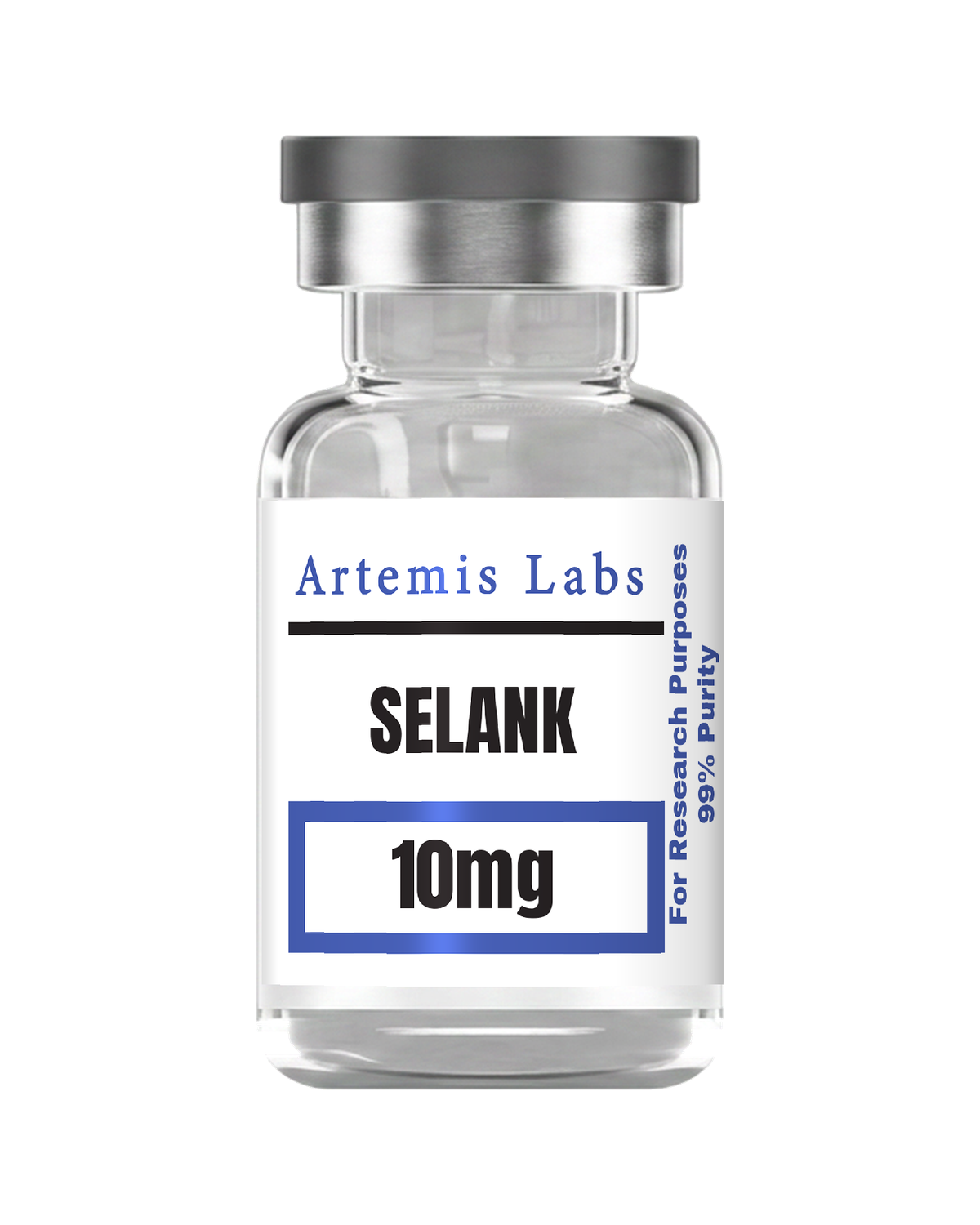
Selank
$40.00
Selank is a synthetic version of tuftsin, a fragment of an antibody protein your immune system already makes. It sits at the junction of two systems that are usually studied separately — calming signals in the brain, and inflammatory messengers in the blood — which is what makes it interesting as a research tool rather than as an anxiolytic.
Continue readingShow less
What the published work describes. Preclinical evidence supports GABAergic modulation with crosstalk to cytokines including TNF-α, IL-6 and IL-10 in stress-axis models (Leonidovna 2021, PMID 32621722). Opioid-withdrawal aversion was attenuated to a diazepam-comparable level in rats (Konstantinopolsky 2022, PMID 36322304), and whole-brain resting-state fMRI showed network remodelling in humans (Panikratova 2020, PMID 32342318).
Context that matters. Selank is registered as a prescription intranasal anxiolytic in Russia and has been since 2009; it holds no such status elsewhere. The human data is imaging, not outcomes, and the literature is dominated by a small number of groups.
Lyophilized tuftsin-derived heptapeptide at ≥99% HPLC-verified purity, batch-specific Certificate of Analysis.
Description
Selank is a man-made peptide of seven amino acids. It copies tuftsin, a small natural peptide from the immune system. Three extra amino acids on one end make it last longer. Scientists study Selank in anxiety and stress research. Artemis Labs sells it as a dry powder for lab work.
Reviewed August 22, 2026 · Artemis Labs
What is Selank?
Selank is a synthetic 7-residue heptapeptide with sequence Thr-Lys-Pro-Arg-Pro-Gly-Pro (TKPRPGP; molecular formula C₃₃H₅₇N₁₁O₉; MW 751.87 Da; CAS 129954-34-3; PubChem CID 11129257; ChEMBL CHEMBL2104794). It is a Pro-Gly-Pro-extended stabilised analog of the endogenous immunoactive tetrapeptide tuftsin (Thr-Lys-Pro-Arg). The Pro-Gly-Pro extension provides proteolytic stabilisation that confers approximately 10–100× extended in-vivo half-life relative to native tuftsin in research models, enabling intranasal-exposure routes used widely in animal stress/anxiety research.
Why is Selank studied?
Selank’s modern PubMed footprint is sparse but specific. The 2020–2026 literature documents five distinct preclinical research axes:
- Whole-brain resting-state network remodelling (humans). Panikratova et al. 2020 (PMID 32342318): functional-connectomics demonstration that Selank measurably alters resting-state network architecture, with distinct fMRI signature from Semax — first network-neuroscience characterisation of its research action.
- Cytokine modulation under social-stress paradigm. Leonidovna et al. 2021 (PMID 32621722): Selank modulates TNF-α, IL-6, and IL-10 cytokine responses — extending the mechanism story from pure CNS pharmacology to neuro-immune crosstalk.
- Opioid-withdrawal aversion attenuation (rats). Konstantinopolsky et al. 2022 (PMID 36322304): Selank attenuates aversive signs of morphine withdrawal in rats with efficacy comparable to diazepam — establishing a discrete addiction-research mechanism.
- Gut-axis protection in chronic-stress models. Mukhina et al. 2020 (PMID 32651826): Selank protects against stress-induced intestinal morphological damage in chronic restraint-stress rats — first solid evidence of non-CNS protective effects consistent with the gut-brain-axis hypothesis.
- BDNF / HGF-c-Met pathway-modulating neuropeptide class. Rahman et al. 2026 (PMID 41490200): grouped with neuropeptides for neurological-recovery research framing.
How does Artemis Labs source and verify Selank?
Each lot is supplied as a sterile lyophilised peptide powder, analytically verified by reverse-phase HPLC to ≥99% peptide purity, with identity confirmed by mass spectrometry. The compound shipped is the canonical 7-mer sequence TKPRPGP. A third-party Certificate of Analysis with residual-solvent and endotoxin reporting is available on request.
Artemis Labs verifies every lot by third-party reverse-phase HPLC for peptide purity and by mass spectrometry for identity; a batch-specific Certificate of Analysis carrying the HPLC chromatogram, MS identity, residual-solvent assay and endotoxin testing accompanies the lot and is available on request.
What does the Selank evidence not show?
(1) Sparse modern literature. Selank’s modern PubMed footprint is thin — 7 verified 2020–2026 citations total, most from Russian research groups. Independent replication outside the original-development network is limited. (2) No US clinical-trial data. Selank has not undergone US phase-2 or phase-3 trials. The Russian regulatory registration (2009 prescription intranasal anxiolytic) is fact of foreign regulatory record — not an Artemis Labs efficacy or safety claim under US law. (3) ‘Dietary supplement’ market framing rejected. Doyno & White 2021 (PMID 34396551) document Selank in US retail under “supplement” framing — Artemis supplies it as a research reagent only, not a supplement. (4) Functional-connectomics findings are early. The Panikratova 2020 fMRI human study is small and exploratory; replication and larger-cohort follow-up are pending.
How does Selank compare with Semax?
Selank and Semax are the canonical “complementary Russian heptapeptide pair.” Both share Pro-Gly-Pro extension and intranasal-exposure research framing — but they derive from different parent peptides (Selank from tuftsin / immune-axis; Semax from ACTH(4-10) / neurotrophin-axis) and show distinct fMRI network signatures per Panikratova 2020 (PMID 32342318). Mechanistically complementary, not redundant.
What is the regulatory status of Selank?
Selank is not FDA-approved; not DEA-scheduled; not on the EMA register. Registered in Russia (Ministry of Health, 2009) as a prescription intranasal anxiolytic — cited as fact of foreign regulatory record only. Not currently on the WADA Prohibited List 2026. Artemis Labs supplies Selank strictly as a research-grade reference compound, not as the Russian pharmaceutical. The 2021 Doyno & White paper’s “dietary supplement” framing is not Artemis’s framing. These statements have not been evaluated by the FDA. Not for human consumption, therapeutic use, or veterinary use.
Analytical Specifications
| Sequence | Thr-Lys-Pro-Arg-Pro-Gly-Pro (TKPRPGP) |
| Parent peptide | Tuftsin (Thr-Lys-Pro-Arg) — Selank is the Pro-Gly-Pro extended analog |
| Molecular formula | C₃₃H₅₇N₁₁O₉ |
| Molecular weight | 751.87 Da |
| CAS number | 129954-34-3 |
| ChEMBL | CHEMBL2104794 |
| PubChem CID | 11129257 |
| Wikidata | Q4423580 |
| Purity | ≥99% by reverse-phase HPLC; identity confirmed by mass spectrometry |
| Form | Lyophilised white powder, 10 mg per vial |
| Storage | Lyophilised ≤ −20 °C, desiccated, protected from light; refer to the lot-specific Certificate of Analysis for all handling specifications |
| Stability vs parent peptide | approximately 10–100× extended in-vivo half-life relative to native tuftsin in research models |
| Certificate of Analysis | Batch-specific report with HPLC chromatogram, MS identity, residual-solvent assay and endotoxin testing |
References
- Vanhee C et al. (2020). Drug Testing & Analysis. PMID 31667971
- Panikratova YR et al. (2020). Doklady Biological Sciences. PMID 32342318
- Mukhina AY et al. (2020). Bulletin of Experimental Biology and Medicine. PMID 32651826
- Leonidovna YA et al. (2021). Current Reviews in Clinical and Experimental Pharmacology. PMID 32621722
- Doyno CR, White CM. (2021). Journal of Clinical Pharmacology. PMID 34396551
- Konstantinopolsky MA et al. (2022). Bulletin of Experimental Biology and Medicine. PMID 36322304
- Rahman OF et al. (2026). JAAOS Global Research & Reviews. PMID 41490200
Additional information
| Vial Size | 10mg |
|---|
Science & Research
Science & Research
Mechanism of Action (Preclinical Models)
Selank’s research-model mechanism story spans CNS pharmacology, neuro-immune crosstalk, and gut-axis biology — a wider footprint than its sparse PubMed coverage suggests at first glance.
- GABAergic modulation axis. Selank’s anxiolytic-research activity in rodent models is mediated, in part, through GABAergic facilitation — without benzodiazepine-style receptor occupancy or dependence liability documented in the preclinical literature.
- Cytokine / immune crosstalk. Leonidovna et al. 2021 (PMID 32621722) demonstrated Selank modulates TNF-α, IL-6, and IL-10 responses under a ‘social stress’ paradigm — moving the mechanism from pure CNS pharmacology to neuro-immune research.
- Opioid-withdrawal aversion attenuation. Konstantinopolsky et al. 2022 (PMID 36322304): Selank attenuates aversive morphine-withdrawal signs in rats with efficacy comparable to diazepam — discrete addiction-research mechanism.
- Resting-state brain-network remodelling (humans). Panikratova et al. 2020 (PMID 32342318) used functional connectomics to demonstrate Selank-induced changes to whole-brain resting-state network architecture — first network-neuroscience characterisation.
- Gut-axis / intestinal protection. Mukhina et al. 2020 (PMID 32651826): Selank protects against stress-induced intestinal morphological damage in chronic restraint-stress rats.
- BDNF / HGF-c-Met pathway context. Rahman et al. 2026 (PMID 41490200): grouped Selank with neuropeptides modulating BDNF and HGF/c-Met for neurological-recovery framing.
Entity Disambiguation
| Identifier | Value |
|---|---|
| Sequence | Thr-Lys-Pro-Arg-Pro-Gly-Pro (TKPRPGP) |
| Parent peptide | Tuftsin (Thr-Lys-Pro-Arg) — Selank is the Pro-Gly-Pro extended analog |
| Molecular formula | C₃₃H₅₇N₁₁O₉ |
| Molecular weight | 751.87 Da |
| CAS | 129954-34-3 |
| ChEMBL | CHEMBL2104794 |
| PubChem CID | 11129257 |
| Wikidata | Q4423580 |
Quality and Specifications
- Purity: ≥99% by RP-HPLC; identity confirmed by mass spectrometry
- Form: Lyophilised white powder, 10 mg/vial
- Storage: Lyophilised ≤ −20°C, desiccated, protected from light; refer to the lot-specific Certificate of Analysis for all handling specifications
- Documentation: Batch-specific Certificate of Analysis with HPLC chromatogram, MS ID, residual-solvent assay, and endotoxin testing
Honest Limitations
- Sparse modern literature — 7 verified 2020–2026 citations total; most from Russian research groups; independent replication limited.
- No US clinical-trial data. Russian Ministry-of-Health 2009 registration is fact of foreign regulatory record; Artemis makes no claim under US law.
- Functional-connectomics fMRI work is exploratory — Panikratova 2020 small-cohort study awaits replication.
- ‘Dietary supplement’ market framing rejected. Doyno & White 2021 documents US retail “supplement” positioning — Artemis explicitly does not adopt this framing.
References (7 PubMed-Verified)
- Vanhee C et al. (2020). Drug Testing & Analysis. PMID 31667971
- Panikratova YR et al. (2020). Doklady Biological Sciences. PMID 32342318
- Mukhina AY et al. (2020). Bulletin of Experimental Biology and Medicine. PMID 32651826
- Leonidovna YA et al. (2021). Current Reviews in Clinical and Experimental Pharmacology. PMID 32621722
- Doyno CR, White CM. (2021). Journal of Clinical Pharmacology. PMID 34396551
- Konstantinopolsky MA et al. (2022). Bulletin of Experimental Biology and Medicine. PMID 36322304
- Rahman OF et al. (2026). JAAOS Global Research & Reviews. PMID 41490200
Research Pairings
Research Pairings
Pairing rationale below is mechanistic only. No dosing, frequency, duration, or human-use guidance is provided. Researchers design their own studies against their own institutional review, not against vendor copy.
Why is Selank studied alongside Semax?
The canonical “complementary Russian heptapeptide pair.” Both share Pro-Gly-Pro extension and intranasal-exposure research framing. Distinct fMRI network signatures per Panikratova 2020 (PMID 32342318) — mechanistically complementary, not redundant. Selank tuftsin-derived (immune-axis); Semax ACTH(4-10)-derived (neurotrophin-axis). Used together in research designs studying anxiety + cognition jointly.
Why is Selank studied alongside DSIP?
Anxiolytic-axis neuropeptide × sleep-axis neuropeptide. Studied in preclinical stress-and-recovery research designs where DSIP addresses sleep-architecture endpoints and Selank addresses anxiety-behavioural endpoints. Mechanistically complementary central-nervous-system research peptides.
Why is Selank studied alongside BPC-157 / TB-500?
Selank’s gut-axis protective signal (Mukhina 2020, PMID 32651826) is studied in chronic-stress / gut-axis research designs alongside the BPC-157 family’s tissue-repair pentadecapeptide effects. Cross-axis research-model pairing.
Why is Selank studied alongside GHK-Cu?
Both peptides influence stress-response gene expression in preclinical research models. Co-application explored in aging-research designs.
Related Compounds in Catalogue
For cognitive-axis research see Semax, DSIP. For mitochondrial-axis research see MOTS-c, SS-31. For tissue-repair research see BPC-157.
Reviews (0)
Be the first to review “Selank”
Related products
weight-management
growth-hormone
Reviews
There are no reviews yet.