
BPC 157 for Sale: What to Check Before Buying It for Research
Buyer’s reference · reviewed August 28, 2026 · Artemis Labs
If you searched for “BPC 157 for sale,” you will find many sellers and very little that tells them apart. Artemis Labs sells BPC 157 for laboratory research, so read this page knowing who wrote it. That is also why every check below is one you can run yourself, on our pages or anyone else’s, in a few minutes.
What does “BPC 157” mean?
BPC 157 and BPC-157 are the same compound. Most journal papers write it with a space; most vendors write it with a hyphen. It is a synthetic peptide of 15 amino acids, with the sequence GEPPPGKPADDAGLV, CAS number 137525-51-0, and a molecular weight of 1,419.54 g/mol. Its full name is Body Protection Compound 157, and older papers also call it PL 14736. The sequence copies part of a protein found in human stomach fluid. Three prolines in a row near the start of the chain make it unusually resistant to being broken down by enzymes; published studies report it stays intact in human gastric juice for more than 24 hours.
Those identity facts matter more than a brand name. A peer-reviewed 2023 analysis of marketed research products sold under several trade names found them misbranded and adulterated (Delcourt et al. 2023, PMID 36482504). In a market like that, the first question is not “which seller,” it is “does the page state what the compound is, precisely enough to check.”
What is actually for sale?
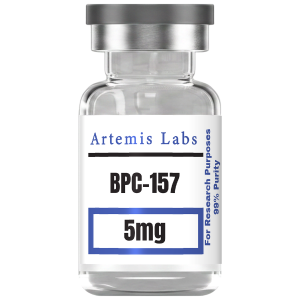
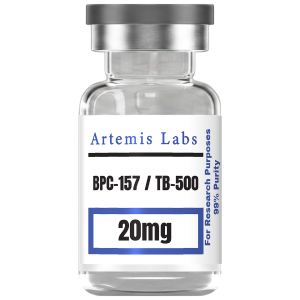
What a research supplier sells is a freeze-dried (lyophilized) powder in a sealed vial, labeled for laboratory research use only. At Artemis Labs that is 5 mg and 10 mg vials of BPC-157, and a pre-formulated combination with the TB-500 fragment for researchers studying two repair pathways side by side. The catalog contains no administration supplies of any kind, and no page on this site provides usage guidance. That is not a gap in the documentation; it is the documentation being consistent with the label.
What does the published research say, and not say?
BPC-157 has one of the deeper preclinical records in the research-peptide category. Published work in rats and in cells describes it acting on several repair pathways at once, not through a single receptor: new-blood-vessel signalling (VEGFR2–Akt–eNOS), a cell-migration pathway called FAK–paxillin, and the nitric-oxide system. In 2026 a study in human internal mammary artery tissue reported concentration-dependent, nitric-oxide-mediated relaxation of the vessel wall (Yildirim et al., PMID 42123221). That was the first human-tissue mechanism evidence, and it was a tissue-bath study on surgical leftovers, not a study in people.
What the record does not contain is just as important to a buyer. There is no published Phase II or Phase III human efficacy trial of BPC-157 for any use. A 2026 review in Sports Medicine puts it plainly: rigorous human safety data are scarce (Mendias and Awan 2026, PMID 41966639). A 2026 physician primer describes the only human case series as small and uncontrolled (Mayfield et al. 2026, PMID 41476424). Every effect you have read about is an animal or tissue finding. A seller whose page says otherwise is describing a literature that does not exist.
Five checks before you buy BPC 157 for research
- The identity is stated, precisely. Sequence, molecular weight and CAS number should be on the page, and they should match the values above. If a page cannot tell you what the compound is, it cannot tell you what is in the vial.
- The research claims link to papers you can open. Every finding should trace to a PubMed record or a DOI. Click two or three. If the links are missing, dead, or lead to papers that do not say what the page says, the rest of the page is marketing.
- The unfavorable findings are on the page too. For BPC-157 that means the absence of human efficacy trials, said plainly. For the BPC-157 / TB-500 combination it also means the 2025 finding that mast-cell-released thymosin β4 impaired the intestinal barrier in IBS models (Sun et al. 2025, PMID 41278163). That finding is specific to the TB-500 side of the pairing, and a page selling the pairing should say so instead of leaving it out.
- The regulatory status is stated, not hidden. BPC-157 is not an FDA-approved drug for any use. It was on the FDA’s 503A compounding Category 2 interim list from September 2023 until September 27, 2024, when it was removed after the nominator withdrew, and it remains under advisory-committee review. It is on the WADA Prohibited List under Section S2, prohibited at all times. A page that leaves the WADA line off is leaving off the one fact a tested athlete or a sports-science lab needs first.
- Policies and price are visible before checkout, and the page gives no usage guidance. Refund, privacy and research-use terms should be published, shipping should be a stated flat rate, and nothing on the seller’s site should tell you how to use the compound. Federal warning letters to research-peptide sellers in December 2024 and March 2026 cited exactly that kind of content as evidence of intended use. A vendor page that offers it is documenting a problem, for the vendor and for the buyer.
What Artemis Labs publishes for BPC-157
The BPC-157 product page carries the identity facts above, 27 linked references, and a limitations section that reports the missing human evidence. Around it sits a set of plain-language research pages, each written from the same verified fact sheet and each linking its sources:
- What is BPC-157 studied for? — the research areas, in plain words
- The human-trials record — what exists and what does not
- Published safety findings and their limits
- Sequence and identity — the facts to check a label against
- BPC-157 vs TB-500 — two different repair pathways compared
- Regulatory status and WADA status
The manufacturer performs periodic quality testing on production batches. Shipping is flat-rate USPS Ground Advantage, free above the order threshold shown at checkout, from the United States. The same checks, applied to the whole category instead of one compound, are in our evaluation framework for research-peptide vendors, and the rest of the tissue-repair family is in the tissue-repair research catalog section.
The compounds discussed on this page
Tissue-Repair Research
References
- Delcourt V, et al. (2023) — marketed research products sold under several trade names found misbranded and adulterated. Drug Test Anal. PMID 36482504
- Yildirim AK, et al. (2026) — endothelium-dependent, nitric-oxide-mediated vasorelaxation of human internal mammary artery ex vivo. J Clin Med 15(9):3488. PMID 42123221
- Mendias CL, Awan TM (2026) — safety and efficacy of approved and unapproved peptide therapies for musculoskeletal injuries. Sports Med. PMID 41966639
- Mayfield CK, et al. (2026) — peptide therapy primer for orthopaedic and sports medicine physicians. Am J Sports Med. PMID 41476424
- Sun Y, et al. (2025) — counter-evidence. Mast-cell-released Tβ4 impaired intestinal epithelial barrier integrity in IBS models. World J Gastroenterol. PMID 41278163
- US FDA — Warning Letters index (research-peptide letters of December 10, 2024 and March 31, 2026). fda.gov
Looking for other compounds? See all research peptides for sale.
For laboratory research use only. Not for human or veterinary consumption. Nothing on this page is medical advice, and no statement has been evaluated by the FDA.