
What Is BPC-157 Studied For? A Plain Guide
Aug
What Is BPC-157 Studied For?
Published August 22, 2026 · Artemis Labs
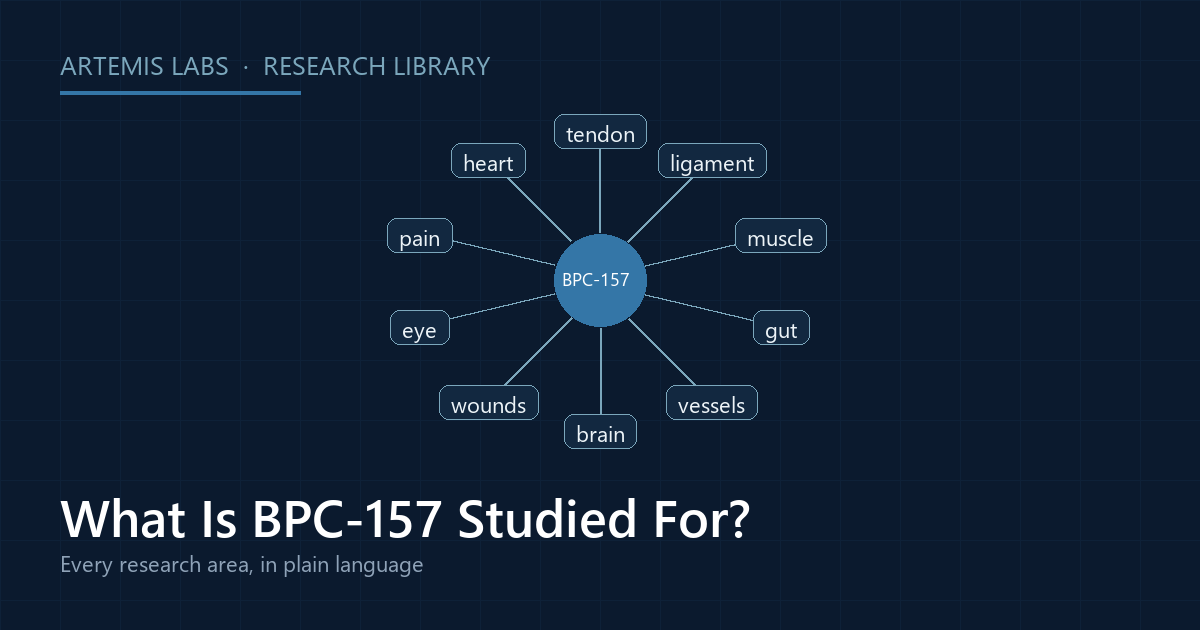
BPC-157 — a 15-amino-acid peptide copied from a fragment of a protein found in human stomach juice. Researchers study it in animals, cells, and tissue samples to watch how injured tendons, ligaments, muscle, gut lining, blood vessels, nerves, skin wounds, eyes, and heart tissue respond. Across those models, published studies have reported faster repair and new blood-vessel growth at injury sites. No published human trial has tested whether it works for any condition, so everything known about BPC-157 comes from preclinical research — studies done before, and so far instead of, human testing.
Key findings
- In a 2010 rat study, a cut knee ligament healed better in animals given BPC-157 than in untreated animals (Cerovecki 2010) — the foundational orthopaedic study.
- In 2011 lab-dish experiments, tendon cells exposed to BPC-157 grew outward, survived, and moved faster than untreated cells (Chang 2011).
- In 2026, strips of human chest artery in a laboratory bath relaxed when exposed to BPC-157 — the first mechanism data in human tissue, from a tissue study, not a clinical trial (Yildirim 2026).
- No published Phase II or Phase III human efficacy trial exists for BPC-157 for any use (Mendias 2026).
Where does BPC-157 come from?
BPC-157 was not invented from scratch. It is a partial copy of a protein that scientists found in human gastric juice — the acid mixture inside the stomach. The lab-made version is a peptide, which means a short chain of amino acids, the building blocks of proteins. This one is 15 amino acids long.
One structural detail matters for research. The chain contains three prolines in a row — proline is one of the amino acids — and published studies link that feature to unusual toughness. BPC-157 stayed intact in human gastric juice for more than 24 hours, which is rare for a small, unmodified peptide. Most peptides break apart quickly in stomach acid.
The BPC-157 research peptide sold for laboratory use is this same 15-amino-acid sequence, supplied as a dry powder.
What is BPC-157 studied for, area by area?
Here is the full map. Each section says what was observed and what kind of model the study used, because the model is the whole story. A rat study is not a human study. A cell in a dish is not a person.
Tendon and ligament repair
This is the best-known research area. In cell-culture work, tendon cells spread, survived, and migrated faster with BPC-157, moving through a signalling route called FAK–paxillin (Chang 2011). A follow-up study reported more growth-hormone receptors on tendon fibroblasts — the cells that build connective tissue (Chang 2014). In rats, a cut medial collateral ligament (a knee ligament) healed better with treatment than without (Cerovecki 2010). Reviews in 2019 and 2026 pulled the soft-tissue findings together (Gwyer 2019; Matek 2026). The full story is on our BPC-157 tendon research page.
Muscle injury models
A 2022 review collected animal studies across skeletal muscle (the kind that moves the skeleton), smooth muscle, and heart muscle (Staresinic 2022). A 2025 paper reviewed rat models in which detached muscle was surgically reattached to bone (Matek 2025). All animal work.
The gut — its home turf
Because BPC-157 comes from a stomach protein, the digestive tract is where its research began. Rat studies reported protection of the gut lining and recruitment of blood vessels to injured tissue (Sikiric 2018). One rat model combined a blocked major vein with a duodenal lesion — an injury to the first part of the small intestine (Amam 2018). Another studied stomach perforation in rats (Kalogjera 2023). We cover this area in depth in BPC-157 gut research.
Blood vessels
Animal and cell studies report new blood-vessel growth at injury sites, and one paper compared BPC-157 directly with standard blood-vessel growth factors (Seiwerth 2018). Then came the 2026 finding worth stating carefully. Strips of human internal mammary artery — a chest artery — were placed in a laboratory tissue bath and exposed to BPC-157. They relaxed, in a concentration-dependent way, through the vessel’s inner lining and a signalling gas called nitric oxide (Yildirim 2026). That is the first mechanism data in human tissue. It is a tissue study of surgical samples, not a trial in living people. Read more on our BPC-157 blood vessel research page.
The brain and nervous system
A 2021 review gathered animal models of brain injury, nerve injury, and neurodegeneration — conditions where nerve cells break down over time (Vukojevic 2021).
Wound repair
In a 2015 study, rats with alkali burns — chemical burns from a caustic substance — showed improved wound closure with treatment; matching cell experiments measured cell growth, movement, and blood-vessel formation in dishes (Huang 2015). A 2016 rat study reported repair of a rectovaginal fistula, an abnormal opening between two body passages (Baric 2016).
The eye
A 2023 review covered animal models of glaucoma — high pressure inside the eye — and other eye conditions (Sikiric 2023).
Pain signals
A 2026 review examined animal findings on pain, tracing a possible mechanism through small blood vessels and dopamine pathways. The authors reported the pain-signal findings as separable from the tissue-repair effects (Yuan 2026).
The heart and circulation
Recent reviews describe animal models of hemorrhage (heavy bleeding) and thrombosis (unwanted clotting) (Sikiric 2026), and animal models of irregular heart rhythm, discussed alongside conventional anti-arrhythmic drug classes (Sikiric 2026b). Again: animals, not people.
What kind of studies are these?
Nearly every study above falls into one of three buckets. Animal studies, mostly rats. Cell studies, where cells grow in a dish. And now one tissue study, where pieces of human artery were tested in a lab bath. These are called preclinical studies — the stage that comes before testing in people. Preclinical results often fail to repeat in humans, which is exactly why human trials exist. For how BPC-157 fits among other repair-focused peptides, see the comparison of BPC-157, TB-500, KPV and GHK-Cu across the tissue-repair cascade or browse the recovery and repair research topic.
What the research does not show
No published Phase II or Phase III human trial has tested whether BPC-157 works for any condition. Pilot human safety work with infusion is referenced in the recent medical literature (Mendias 2026; Mayfield 2026), but safety data is not efficacy data. Every claim you may have seen about what BPC-157 “does” in people is an extrapolation from animal, cell, or tissue studies. There is also no single defined receptor for BPC-157, no standard lab assay that defines a positive response, and effect sizes vary widely across models, doses, routes, and species. For FDA status, sport rules, and the rest of the fine print, see BPC-157 safety research.
Frequently asked questions
Has BPC-157 been tested in humans?
Only in a limited way. Pilot infusion safety work is referenced in the medical literature, but no published Phase II or Phase III trial has measured whether it helps any human condition (Mendias 2026).
Is BPC-157 approved by the FDA?
No. It is not an approved drug for any use. Its status in pharmacy compounding has shifted several times — it was removed from an interim compounding list in September 2024 and remains under advisory-committee review, with a non-binding committee vote in July 2026. The situation is unsettled.
Can athletes use BPC-157?
Tested athletes should know it sits on the WADA Prohibited List under Section S2, banned at all times, in and out of competition. Using it risks an anti-doping violation regardless of source or intent.
Which research area has the most evidence?
Tendon, ligament, and gut models make up the deepest part of the literature, starting with the 2010 rat ligament study (Cerovecki 2010) and the gut studies that gave the compound its name. All of it remains preclinical.
References
- Cerovecki T, et al. (2010). Ligament healing in a rat MCL transection model. DOI: 10.1002/jor.21107
- Chang CH, et al. (2011). Tendon-cell outgrowth, survival, and migration via FAK–paxillin. DOI: 10.1152/japplphysiol.00945.2010
- Chang CH, et al. (2014). Growth-hormone-receptor expression in tendon fibroblasts. DOI: 10.3390/molecules191119066
- Gwyer D, et al. (2019). Soft-tissue-healing review. DOI: 10.1007/s00441-019-03016-8
- Matek D, et al. (2026). Tendon, ligament, and muscle mechanism review. PMID 41754849
- Staresinic M, et al. (2022). Striated, smooth, and heart muscle model review. DOI: 10.3390/biomedicines10123221
- Matek D, et al. (2025). Rat muscle-to-bone reattachment models. PMID 39861766
- Sikiric P, et al. (2018). Cytoprotection synthesis: vascular recruitment and GI-tract healing. DOI: 10.2174/1381612824666180608101119
- Amam Z, et al. (2018). Major venous occlusion plus duodenal lesion, rat model; NO-pathway pharmacology. DOI: 10.3748/wjg.v24.i47.5366
- Kalogjera L, et al. (2023). Stomach-perforation / occlusion-syndrome rat model. DOI: 10.3748/wjg.v29.i27.4289
- Seiwerth S, et al. (2018). BPC-157 compared with standard angiogenic growth factors. DOI: 10.2174/1381612824666180712110447
- Yildirim S, et al. (2026). Endothelium-dependent, NO-mediated relaxation of human internal mammary artery, ex vivo tissue bath. PMID 42123221
- Vukojevic J, et al. (2021). CNS injury and neurodegeneration animal-model review. DOI: 10.4103/1673-5374.320969
- Huang T, et al. (2015). Alkali-burn wound healing in vivo; proliferation, migration, angiogenesis in vitro. DOI: 10.2147/DDDT.S82030
- Baric M, et al. (2016). Rectovaginal fistula repair in rats. DOI: 10.1016/j.lfs.2016.02.029
- Sikiric P, et al. (2023). Glaucoma and ocular-condition animal-model review. DOI: 10.3390/ph16071052
- Yuan L, et al. (2026). Analgesic-mechanism review: microvascular and dopaminergic pathways. PMID 41898733
- Sikiric P, et al. (2026). Cytoprotection framing for hemorrhage and thrombosis, animal models. PMID 41901308
- Sikiric P, et al. (2026). Arrhythmia-model review alongside conventional antiarrhythmic classes. PMID 41754776
- Mendias CL, Awan TM. Sports Med. 2026. PMID 41966639
- Mayfield CK, et al. Am J Sports Med. 2026. PMID 41476424
Related: BPC 157 for sale: what to check before buying it for research · the BPC-157 product page (27 linked references).
Methodology: This page draws solely on the Artemis Labs BPC-157 product research record (PMID- and DOI-verified citations), last verified August 22, 2026.
All compounds sold by Artemis Labs are for laboratory research use only. Nothing on this page is medical advice, and no statement has been evaluated by the FDA.
This article is part of the Tissue-Repair Research product class. The class page lists every compound in it with sequence, molecular weight and the sources cited.
