
BPC-157 Doses Used in Published Research
Aug
BPC-157 Doses Used in Published Research
Published August 23, 2026 · Artemis Labs
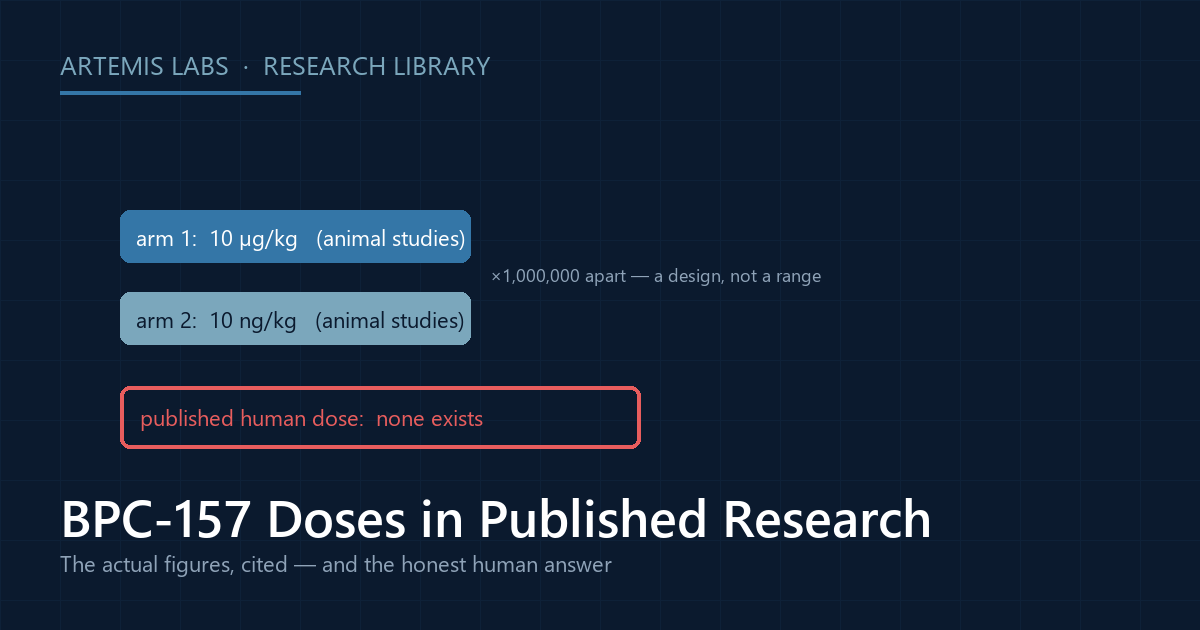
BPC-157 doses in published research — answer capsule: The published animal studies mostly used one two-arm design: 10 micrograms per kilogram of body weight in one group and 10 nanograms per kilogram in another — two fixed test amounts a millionfold apart, not a range to pick from. The one human-tissue study bathed artery samples in 0.01 to 1 mg/mL solutions in a lab container. And for humans, the honest answer is that no published human dose exists: the only human case series in the review literature is described by its own reviewers as having unknown dosing and no controls. Everything on this page is a study parameter from a cited experiment — nothing on this page is usage guidance, because no such guidance exists in the scientific record.
Key findings
- The recurring published animal design is 10 µg/kg and 10 ng/kg — two separate test arms, described in the review literature as “equipotent (μg, ng/kg) in parenteral or peroral regimens” (Sikiric 2013, PMID 22950504).
- Those figures appear across the foundational rat studies: ligament (Cerovecki 2010, PMID 20225319), fistula repair (Baric 2016, PMID 26872976), stomach perforation (Kalogjera 2023, PMID 37545637), and muscle-to-bone reattachment (Matek 2025, PMID 39861766).
- The 2026 human-tissue study used 0.01–1 mg/mL — a concentration in a laboratory tissue bath holding artery samples, not an amount given to anyone (Yildirim 2026, PMID 42123221).
- No human dose has ever been published. The 2026 physician review that examined the only human case series states that “information regarding the indications, dosing, frequency, and duration of treatment remains unknown” (Mayfield 2026, PMID 41476424).
Why publish this page at all?
Because the question gets asked constantly, and most of the answers online are made up. Sites that sell or promote peptides publish detailed human dosing charts, calculators, and schedules for BPC-157. None of that comes from the scientific literature, because the scientific literature contains no human dosing study. What the literature does contain is a set of animal experiments and one tissue study, each of which recorded exactly what amounts were used. Reporting those numbers, with their sources, is the only honest version of this page anyone can write.
So one thing before the numbers: these are descriptions of experiments, reported in past tense from cited papers. They are not instructions, starting points, or suggestions. An amount that a rat received in a controlled surgical experiment tells you nothing about any human anything — a point the researchers themselves make, which is why no reviewer has ever proposed a human dose in print.
What amounts did the animal studies use?
Reading across the foundational rat studies, the same two figures keep appearing: 10 micrograms per kilogram of the animal’s body weight, and 10 nanograms per kilogram. A microgram is a millionth of a gram; a nanogram is a thousandth of that. So the two arms are a millionfold apart — and the striking, much-discussed feature of this literature is that the papers report effects in both.
A 2013 review by the group behind most of this work put it in one sentence: the reported effects “were obtained using the equipotent dosage (μg, ng/kg) in parenteral or peroral regimens” (Sikiric 2013, PMID 22950504). “Equipotent” means the two very different amounts appeared to work about equally well in those models — which is unusual, and which the field has not fully explained.
Study by study, as stated in each abstract:
- Ligament (rat): once daily into the abdominal cavity at “10 microg or 10 ng/kg”; or as a thin cream layer on the injury site (1.0 µg per gram of cream — a formulation mix, not a body-weight dose); or in the drinking water at 0.16 µg/mL, about 12 mL per rat per day (Cerovecki 2010, PMID 20225319).
- Fistula repair (rat): the same 10 µg/kg / 10 ng/kg pair, given in drinking water or into the abdominal cavity (Baric 2016, PMID 26872976).
- Stomach perforation (rat): 10 µg or 10 ng/kg placed directly into the stomach defect five minutes after injury (Kalogjera 2023, PMID 37545637).
- Muscle-to-bone reattachment (rat): by mouth at 10 µg or 10 ng per kg per day (Matek 2025, PMID 39861766).
- Vein-blockage model (rat): applied as a bath at the blocked vessel (“10 μg, 10 ng/kg per 1 mL bath/rat” as printed) or into the stomach at 10 µg/kg (Amam 2018, PMID 30598581).
Notice what these routes actually are: a bath at a surgically exposed vessel, placement into a stomach defect, cream on a cut ligament, drinking water. These are surgical and local laboratory methods matched to each injury model. Describing this literature as if it were a set of ordinary dosing studies would misstate it.
Also worth stating plainly: several of the best-known cell studies published no numbers at all in their abstracts. The tendon-cell work (Chang 2011, DOI: 10.1152/japplphysiol.00945.2010; Chang 2014, DOI: 10.3390/molecules191119066) and the burn-wound study (Huang 2015, DOI: 10.2147/DDDT.S82030) describe their results only as “dose-dependent.” Where a paper states no number, this page attaches none.
What about the human-tissue study?
The 2026 study that moved BPC-157 research into human tissue did not give the compound to any person. Surgeons saved leftover segments of internal mammary artery from twelve bypass operations, kept the rings alive in a laboratory organ bath, and added BPC-157 to the bath in rising concentrations from 0.01 to 1 mg/mL, measuring how the vessel rings relaxed (Yildirim 2026, PMID 42123221). A bath concentration is a property of the liquid in the container. It has no translation into an amount for a living person, and the authors propose none.
So what is the published human dose?
There is none. That is the entire answer, and it is worth spelling out because this page exists to be checked against the record:
- No Phase II or Phase III human trial of BPC-157 has been published for any use — so no dose has ever been tested for effectiveness in people. Our page on BPC-157 human trials walks through what each trial phase means.
- The only human case series named in the 2026 physician review literature involved the compound given into the knee joint — and the reviewers’ own words are that it had “significant methodological flaws and a lack of controls,” and that “information regarding the indications, dosing, frequency, and duration of treatment remains unknown” (Mayfield 2026, PMID 41476424).
- A second 2026 review notes that human research “remains limited to small pilot studies” — and states no dose for any of them (Yuan 2026, PMID 41898733).
- A third, surveying unapproved peptides for sports-medicine physicians, concludes that “rigorous human safety data are scarce, and there is potential for serious harm to patients” (Mendias 2026, PMID 41966639).
Any website, clinic, or influencer that states a human BPC-157 dose is presenting a number the scientific literature does not contain. That is not a matter of opinion; it is checkable against every citation above.
What the research does not show
This page reports study parameters, and study parameters are the weakest kind of evidence there is — they tell you what researchers tried, not what works. The two-arm µg/ng design has a known oddity (a millionfold gap with similar reported effects) that the field has not explained, and effect sizes across this corpus vary substantially with model, dose, route, and species. No published Phase II or Phase III human efficacy trial exists for BPC-157 for any use, its FDA compounding status is unsettled, and it is prohibited at all times for tested athletes under WADA Section S2 — see our safety research summary and regulatory status page. Nothing here supports any statement about what any amount does in a person.
Frequently asked questions
Is there a recommended dose of BPC-157?
No. There is no approved use, no published human efficacy trial, and no published human dosing study. Anyone providing a “recommended dose” is not getting it from the scientific literature.
Why do the animal studies use two amounts a millionfold apart?
That is the two-arm design the originating lab has used for decades — 10 µg/kg and 10 ng/kg — and its papers report effects in both arms, calling them “equipotent.” Why such different amounts would behave similarly is an open question in this literature, not a settled fact.
Can the animal figures be converted to a human amount?
No published work makes that conversion for BPC-157, and this page will not either. Species differ in how they process peptides, the routes in these studies were mostly surgical or local, and no human trial exists to anchor any conversion.
Where can I read the original numbers?
Every figure on this page links to its PubMed record in the References below.
References
- Sikiric P, et al. (2013). Toxicity by NSAIDs and counteraction by BPC 157; states the equipotent (μg, ng/kg) regimens. Curr Pharm Des. PMID 22950504
- Cerovecki T, et al. (2010). Ligament repair in a rat MCL transection model; doses as quoted. J Orthop Res. PMID 20225319 / DOI: 10.1002/jor.21107
- Baric M, et al. (2016). Rectovaginal fistula repair in rats; doses as quoted. Life Sci. PMID 26872976
- Kalogjera L, et al. (2023). Stomach-perforation model; doses as quoted. World J Gastroenterol. PMID 37545637
- Matek D, et al. (2025). Rat muscle-to-bone reattachment; per-oral 10 µg / 10 ng per kg/day. Pharmaceutics. PMID 39861766
- Amam F, et al. (2018). Vein-occlusion model; bath and intragastric parameters as printed. World J Gastroenterol. PMID 30598581
- Yildirim AK, et al. (2026). Human internal mammary artery rings ex vivo; 0.01–1 mg/mL cumulative concentrations. J Clin Med. PMID 42123221
- Mayfield CK, et al. (2026). Physician review; human case-series dosing “remains unknown.” Am J Sports Med. PMID 41476424
- Yuan C, et al. (2026). Review; human research limited to small pilot studies, no doses stated. Int J Mol Sci. PMID 41898733
- Mendias CL, Awan TM. (2026). Review of approved and unapproved peptide therapies; human safety data scarce. Sports Med. PMID 41966639
- Chang CH, et al. (2011). Tendon-cell outgrowth via FAK–paxillin; no dose stated in abstract. DOI: 10.1152/japplphysiol.00945.2010
- Huang T, et al. (2015). Alkali-burn wound model; no dose stated in abstract. DOI: 10.2147/DDDT.S82030
Methodology: every dose and concentration on this page was verified verbatim against its PubMed abstract via NCBI E-utilities on August 23, 2026; where an abstract states no number, this page states none. No figure here is advice, and no human dose exists in the published literature to report.
All compounds sold by Artemis Labs are for laboratory research use only. Nothing on this page is medical advice, and no statement has been evaluated by the FDA.
